

In this article 10 sections
AI can now produce useful code in seconds.
That is a meaningful engineering advance. Controlled studies have already shown that AI assistance can reduce completion time for some development tasks 1.
But faster code does not automatically create faster engineering.
Every new implementation still has to fit an architecture, survive review, satisfy security expectations, behave correctly in production, and remain understandable months later. When code production accelerates without those capabilities accelerating with it, the bottleneck simply moves downstream.
The result can be more pull requests, more dependencies, more operational surface—and less confidence.
The scarce resource is shifting
Software organizations have traditionally treated implementation capacity as scarce. More engineers and better tools meant more features could be built.
AI changes that equation. Code is becoming easier to generate, modify, and reproduce. The scarce resource moves toward engineering judgment:
- Is this the right problem to solve?
- Does the change strengthen or fragment the architecture?
- What evidence shows that it works?
- Which risks and dependencies does it introduce?
- Can the team operate, recover, and improve it?
These questions cannot be answered by code volume.
Five constraints become more important
1. Architecture
AI can generate a new service faster than a team can decide whether another service should exist. Without clear boundaries and platform standards, local speed creates system-wide complexity.
2. Review
If implementation output doubles while review capacity remains fixed, the organization has not removed a bottleneck. It has created a queue. Review must focus on consequential decisions, supported by tests, rationale, dependency changes, and risk evidence.
3. Evaluation
Plausible code is not proven code. Teams still need evidence for functional behaviour, failure modes, security, performance, and operational readiness. AI should help produce this evidence—not only the implementation.
4. Security
Generation speed can multiply insecure patterns and unexamined dependencies just as easily as good practices. Secure development responsibilities remain part of the lifecycle, as reflected in the NIST Secure Software Development Framework 3.
5. Operations
Every additional component creates ownership, observability, cost, incident, and recovery obligations. Research on technical debt in machine-learning systems offers a useful warning: the visible code is only a small part of the production engineering burden 2.
A decision framework for AI-assisted change
Faster implementation creates more possible changes. It does not tell a team which changes deserve to move forward.
Before accepting an AI-assisted change, teams should make five connected decisions:
- Intent — Does it improve a defined outcome? Clarify the need, user, and value before evaluating the implementation.
- Fit — Does it strengthen system coherence? Prefer reuse, explicit boundaries, and understood dependencies over unnecessary expansion.
- Evidence — Is proof proportionate to risk? Require tests, evaluation, and security evidence that match the consequence of failure.
- Readiness — Can the team own and recover it? Confirm operational ownership, cost, observability, and rollback before release.
- Outcome — Did production evidence validate value? Use real outcomes to continue, revise, reuse, or retire the change.
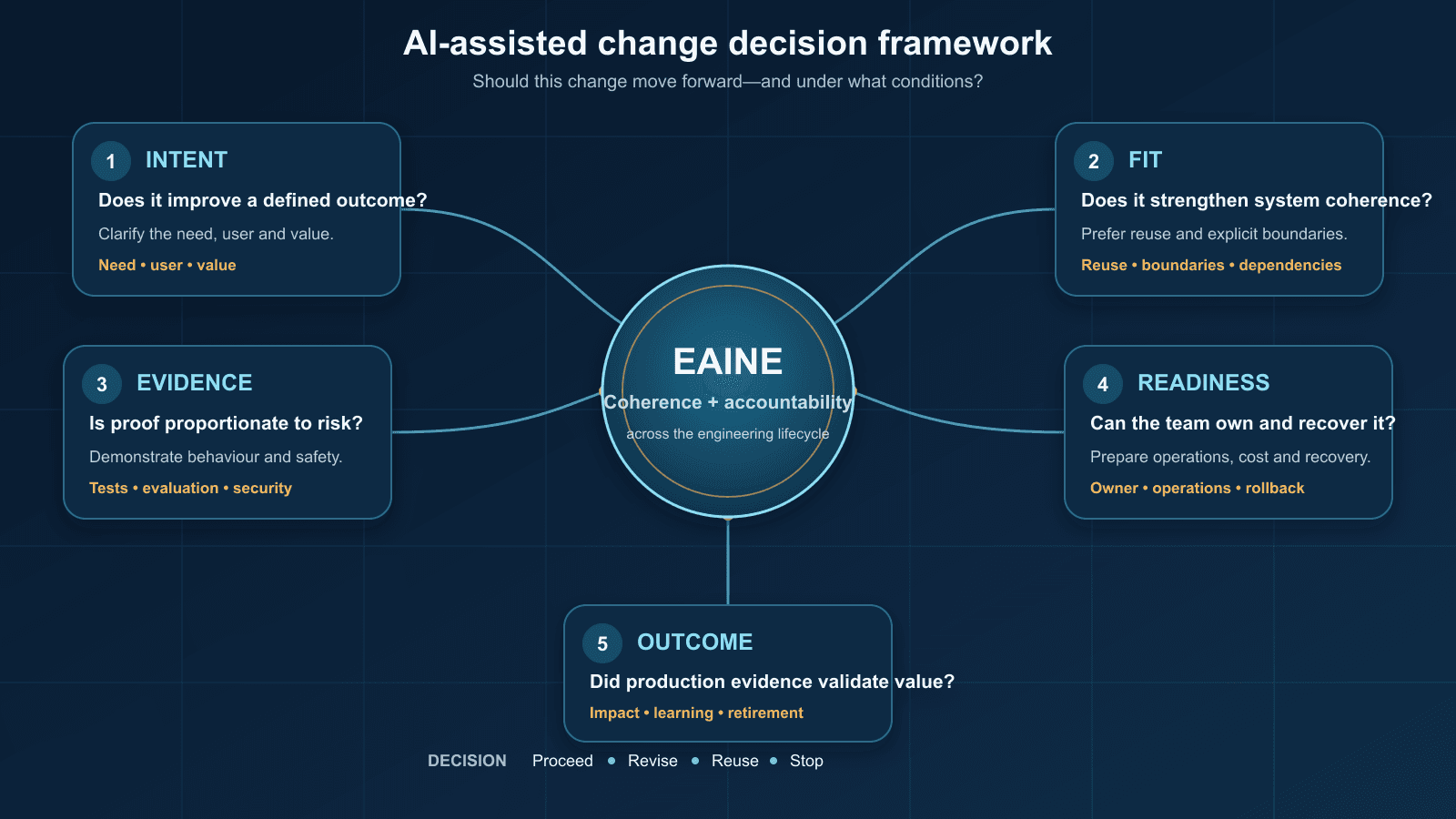 EAINE — AI-Assisted Change Decision Framework · EAINE original editorial framework
EAINE provides the connective engineering discipline across these decisions: coherence from intent through architecture and evidence, and accountability from release through operation and learning. It is not an additional approval layer. It keeps local implementation speed aligned with the quality of the whole system.
The result is not always “proceed.” A sound engineering decision may be to revise the change, reuse an existing capability, narrow the scope, or stop entirely.
A better definition of productivity
In an AI-assisted environment, lines of code, pull-request volume, and feature count become even weaker measures of engineering performance.
A better question is:
How quickly can the team deliver a trusted change that improves an outcome without weakening the system around it?
That definition rewards coherent architecture, effective reuse, strong evidence, smaller operational surface, and the discipline to avoid unnecessary code.
Sometimes the most productive use of AI will be generating an implementation.
Sometimes it will be discovering that an existing capability can be reused.
Sometimes it will be deleting complexity.
What engineering leaders should change now
Teams do not need to slow down AI-assisted development. They need to expand the system around it.
Three practical moves matter:
- Give AI architectural boundaries, not only coding instructions. Make approved patterns, interfaces, dependencies, and ownership visible at the point of implementation.
- Require evidence with every meaningful change. Tests, evaluation results, security findings, operational impact, and decision rationale should travel with the code.
- Measure flow to trusted production outcomes. Do not celebrate generation speed while review queues, incidents, rework, or maintenance load grow.
The future of engineering will not be defined by how much code AI can produce.
It will be defined by whether organizations can turn faster implementation into systems that remain coherent, secure, operable, and worth changing.
AI makes code faster.
Engineering still has to make it good.
References
- The Impact of AI on Developer Productivity: Evidence from GitHub CopilotPeng et al.Accessed August 17, 2026
- Hidden Technical Debt in Machine Learning SystemsGoogle ResearchAccessed August 17, 2026
- Secure Software Development Framework (SSDF) Version 1.1National Institute of Standards and TechnologyAccessed August 17, 2026
Publication detailsVersion 1.1.0 · Updated August 18, 2026 · Editorially approved
- v1.1.0
Added a five-decision framework that connects intent, architectural fit, evidence, operational readiness, and production outcomes through EAINE coherence and accountability.
- v1.0.0
Approved and published the Monday Future of Engineering article with verified evidence, accessible artwork, and dedicated sharing metadata.
- v0.1.0
Created the Monday Future of Engineering article and its dedicated social-preview illustration.