
In this article 16 sections
Everyone is building agents. Few are engineering adaptive systems.
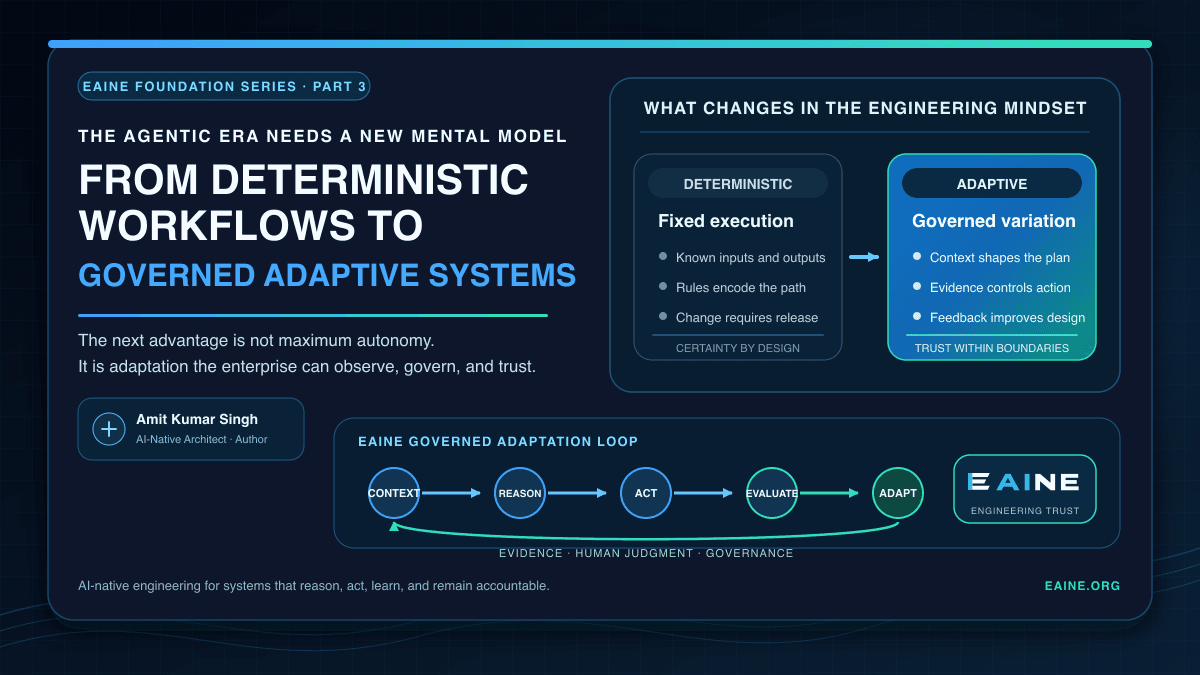
The agentic era is arriving inside the workforce. Teams are building copilots that draft, assistants that retrieve, and agents that plan work, call tools, update systems, and coordinate with other agents.
That is exciting because AI is moving from answering questions to participating in outcomes. It is also the point where a prompt-centric mindset stops being enough.
A chatbot can be judged by the quality of a response. An enterprise agent must also be judged by the context it used, the permissions it exercised, the action it took, the evidence it produced, and whether a person could understand, interrupt, or correct it.
EAINE's position is simple:
The next advantage will not come from making AI sound more autonomous. It will come from engineering adaptation that the enterprise can observe, govern, and trust.
The deterministic contract is breaking
Traditional software is built around a powerful contract: defined input, encoded logic, repeatable output. We test expected paths and treat variation as an exception.
Agentic systems operate under a different contract:
- intent may be incomplete or ambiguous,
- context changes by user, role, market, policy, and time,
- models can produce multiple plausible plans,
- tools and data sources may fail independently,
- the best action depends on risk and consequence,
- feedback can change the next decision.
This does not make engineering less important. It raises the bar. The system still needs dependable behavior, but dependability can no longer mean identical output every time. It must mean controlled variation within explicit boundaries.
The EAINE mental model: engineer controlled uncertainty
An adaptive system does not give an agent unlimited freedom. It gives the system a disciplined way to choose, act, evaluate, and improve.
The EAINE operating chain is:
Intent -> Context -> Reasoning -> Bounded Action -> Evaluation -> Adaptation
                       |                    |
                       +----- Governance ---+
                                                 |
                                              Evidence
Each transition is an engineering surface.
- Intent defines the business objective, not merely the user's latest sentence.
- Context assembles authoritative data, policy, history, permissions, and constraints.
- Reasoning creates options and plans without becoming the final authority.
- Bounded action limits what tools can do, on whose behalf, and under which conditions.
- Evaluation tests quality, safety, policy compliance, and business impact.
- Evidence records the basis, results, interventions, and outcomes needed for review and adaptation.
- Adaptation improves prompts, retrieval, routing, tools, policy, or workflow design.
- Governance remains active across the loop instead of appearing only at approval time.
This is the EAINE difference: intelligence is not treated as an isolated model capability. It is engineered as a governed operating system for outcomes.
The adaptive operating loop
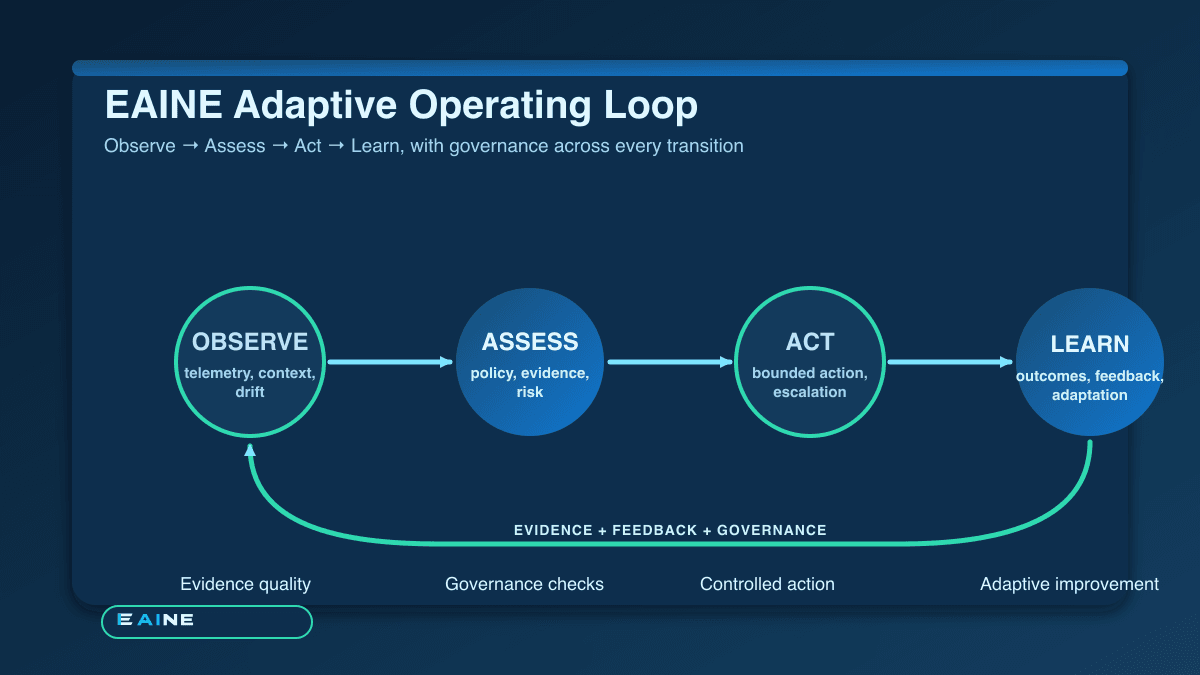
The operating chain describes the system's engineering responsibilities. In production, those responsibilities can be compressed into a continuous runtime loop:
- Observe the request, operating environment, relevant signals, and signs of drift.
- Assess intent, evidence quality, policy, confidence, and consequence.
- Act through approved tools with least privilege, limits, and escalation paths.
- Learn from outcomes, human corrections, exceptions, and operational telemetry.
 EAINE · EAINE proprietary architecture illustration
Learning here does not automatically mean retraining a foundation model. Often the safest and fastest adaptation is a change to context assembly, tool selection, workflow routing, evaluation criteria, or policy. Research on reasoning-and-acting agents and feedback-driven reflection provides useful technical precedents for parts of this loop, although enterprise adaptation requires additional system-level controls. 3 4
The loop also aligns with a key risk-management principle: governance and evaluation belong throughout the AI lifecycle, not as a final compliance gate. The NIST AI Risk Management Framework and its Generative AI Profile similarly emphasize lifecycle-wide governance, measurement, and management. 1 2
An EAINE architecture for the agentic workforce
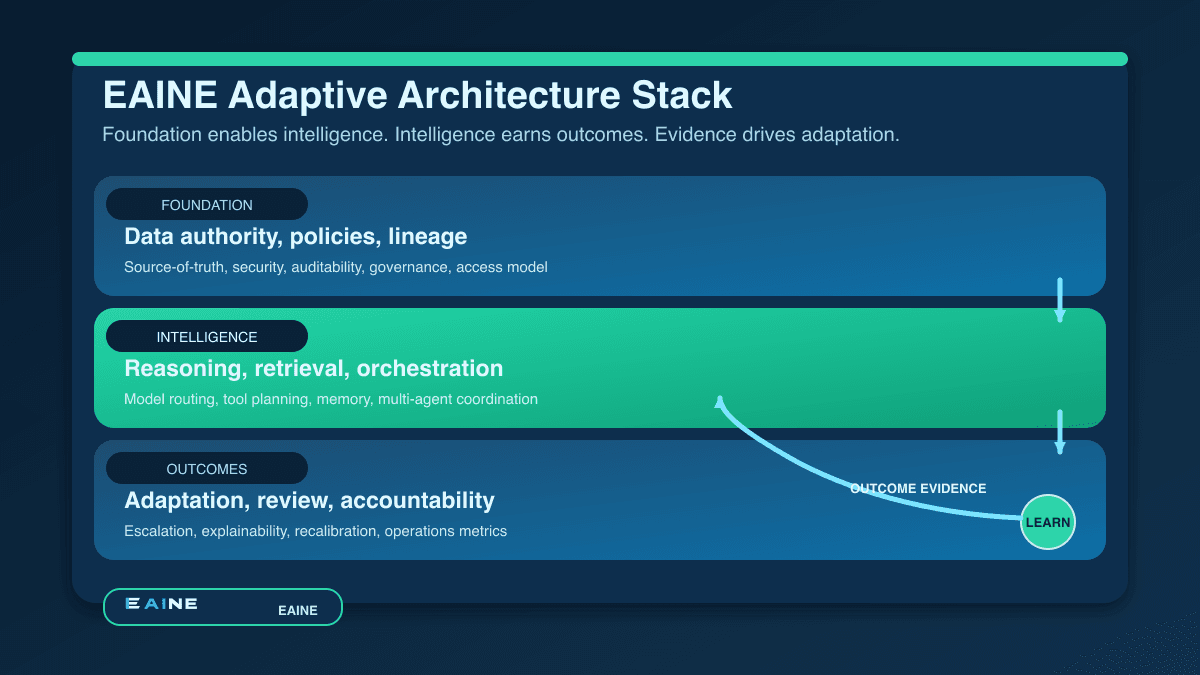
Agentic capability becomes useful at enterprise scale when three architectural lanes reinforce one another.
1. Foundation: make context authoritative
The foundation lane establishes identity, permissions, source-of-truth data, policy, lineage, security, and auditability. Without this layer, an agent may reason fluently over the wrong information or act with excessive access.
2. Intelligence: orchestrate, do not merely prompt
The intelligence lane combines retrieval, memory, reasoning, model routing, planning, and tool orchestration. Models can change. The orchestration contract should preserve controls, evaluation, and traceability across those changes.
3. Outcomes: close the evidence loop
The outcomes lane measures whether the system created value within its boundaries. Human review, escalation, explainability, correction, and operational metrics turn each deployment into an evidence-producing system.
 EAINE · EAINE proprietary architecture illustration
The arrows matter. Foundation enables intelligence. Intelligence earns the right to act. Outcomes return evidence to the system. That feedback updates the design without quietly removing human accountability.
What changes for people in the workforce
The strongest agentic workforce is not a collection of digital employees operating in the dark. It is a collaboration model in which people set direction and consequence while AI expands speed, reach, and analytical capacity.
Roles evolve:
- domain experts define what a good outcome means,
- engineers design context, tools, controls, and recovery paths,
- risk and compliance teams encode policy as an operating capability,
- employees review exceptions and improve the system through correction,
- leaders measure realized outcomes rather than counting AI interactions.
Human involvement should be risk-based. Low-impact, reversible work can run with broader autonomy. Higher-impact actions require proportionately stronger controls, evidence, and accountability. Depending on consequence and policy, that may include explicit human approval.
A practical implementation blueprint
Teams building agents today can start with seven concrete moves:
- Choose one bounded outcome. Start with a measurable workflow, not a general-purpose autonomous employee.
- Define the context contract. Specify approved sources, freshness, identity, permissions, and missing-data behavior.
- Design tool contracts. Give each action typed inputs, least privilege, idempotency where possible, timeouts, and rollback or compensation.
- Create evaluation gates. Test task quality, policy compliance, safety, grounding, latency, cost, and business impact.
- Set autonomy by consequence. Decide what the agent may do, what requires confirmation, and what must always escalate.
- Instrument the full decision path. Capture context sources, model and tool choices, actions, evidence, human interventions, and outcomes.
- Turn feedback into controlled change. Route corrections into prompts, retrieval, policies, tools, tests, and architecture through an owned release process.
Measure the system, not just the model
Model benchmarks alone cannot establish whether an enterprise agent is dependable in operation. An EAINE scorecard should include:
- Outcome metrics: completion quality, cycle time, adoption, and realized business value.
- Control metrics: unauthorized-action rate, escalation precision, reversibility, and policy violations.
- Evidence metrics: groundedness, trace completeness, evaluation coverage, and explanation usefulness.
- Learning metrics: repeated-error rate, time to correction, drift detection, and improvement after intervention.
- Human metrics: override frequency, review burden, user confidence, and whether accountability remains clear.
These measures make adaptation visible. They also prevent a familiar failure mode: optimizing an agent for task completion while moving risk, rework, or cognitive load elsewhere.
Avoid the autonomy theater trap
An agent is not mature because it can execute a long chain without asking for help. Long autonomous runs can simply hide accumulated uncertainty.
Watch for these anti-patterns:
- treating prompt changes as architecture,
- giving agents broad credentials because integration is easier,
- using model confidence as business confidence,
- storing memory without lineage, retention, or correction rules,
- collecting feedback without an owner or release mechanism,
- adding a human approval click that provides no evidence for a real decision.
The goal is not maximum autonomy. The goal is appropriate autonomy with maximum clarity.
EAINE perspective
The agentic era creates a rare opportunity to redesign how software and people produce outcomes together. Enterprises should be ambitious about that opportunity.
But ambition needs architecture.
EAINE frames AI-native engineering as the discipline of turning probabilistic intelligence into dependable, accountable, continuously improving systems. Models provide reasoning power. Context gives that power relevance. Tools give it reach. Governance gives it boundaries. Evidence gives it credibility. People give it purpose.
That is how organizations move from experimenting with agents to building an adaptive workforce they can trust.
Key takeaways
- The agentic era is a systems transformation, not a prompt upgrade.
- Dependability now means controlled variation within explicit trust boundaries.
- Context, tools, evaluation, and governance are first-class architecture components.
- Human oversight should be designed by consequence, not added as a generic checkbox.
- Feedback creates value only when it enters an owned and testable adaptation process.
- EAINE's signature is governed adaptation: intelligence at the core, evidence in the loop, and accountability at every step.
Continue the Foundation Series
- Previous: The AI Model Is Not the System: Why Enterprises Need AI-Native Architecture
- Next: Enterprise AI-Native Engineering: From Detection Intelligence to Discovery Intelligence
References
- 1 NIST AI Risk Management Framework 1.0
- 2 NIST Generative AI Profile
- 3 ReAct: reasoning and acting in language models
- 4 Reflexion: language agents with feedback-driven reflection
References
- Artificial Intelligence Risk Management Framework (AI RMF 1.0)National Institute of Standards and TechnologyAccessed August 16, 2026
- Artificial Intelligence Risk Management Framework: Generative Artificial Intelligence ProfileNational Institute of Standards and TechnologyAccessed August 16, 2026
- ReAct: Synergizing Reasoning and Acting in Language ModelsarXivAccessed August 16, 2026
- Reflexion: Language Agents with Verbal Reinforcement LearningarXivAccessed August 16, 2026
Publication detailsVersion 1.2.1 · Updated August 16, 2026 · Editorially approved
- v1.2.1
Clarified evaluation and evidence, strengthened source traceability, qualified autonomy guidance, and improved image accessibility.
- v1.2.0
Reframed Part 3 for the agentic era with the EAINE governed-adaptation model and refined publication visuals.
- v1.1.0
Restored the three original Adaptive Systems publication visuals.
- v1.0.0
Published a draft-adapted Part 3 for the EAINE Foundation Series.
Public reviewers: Editorial Review Team, Editorial Review Team