
In this article 15 sections
Artificial intelligence has become remarkably good at detection.
Organizations can identify anomalies, classify documents, recognize fraud patterns, summarize information, monitor operational signals, and flag known risks at a scale that was difficult to imagine a few years ago.
This capability has created real value.
But detection is only the beginning.
The next stage of enterprise intelligence will not be defined only by systems that can identify what happened. It will be defined by systems that can help organizations understand why it happened, what it means, what may happen next, and what should be done about it.
This is the shift from Detection Intelligence to Discovery Intelligence.
And I believe this shift will become an important part of the evolution toward Enterprise AI-Native Engineering.
Detection Solves a Known Question
Detection systems usually begin with a question we already understand.
Is this transaction fraudulent? Is this service behaving abnormally? Does this document belong to a particular category? Has an operational threshold been breached?
The objective is known. The signal is known. The system evaluates available information against a defined condition and produces an answer.
This is useful because the problem is already understood. The organization knows what it is looking for, and AI helps find it faster, more consistently, or at much greater scale.
Traditional machine learning has been extremely effective in this space.
But many important enterprise problems do not begin with a clearly defined question.
They begin with uncertainty.
Something has changed. Performance is degrading. Customer behaviour is shifting. A process is producing unexpected outcomes. The organization can see that something matters, but it may not yet know what question to ask.
That is where detection starts to reach its limit.
Discovery Starts Before the Question Is Fully Known
Discovery intelligence operates differently.
Instead of asking only:
“Did a known condition occur?”
the system begins exploring:
“What is changing?”
“Which signals are related?”
“What explanation best fits the evidence?”
“What should we investigate next?”
This changes the role of AI.
The system is no longer only answering predefined questions. It begins helping humans discover the questions that matter.
That is a much deeper capability.
A Simple Enterprise Example
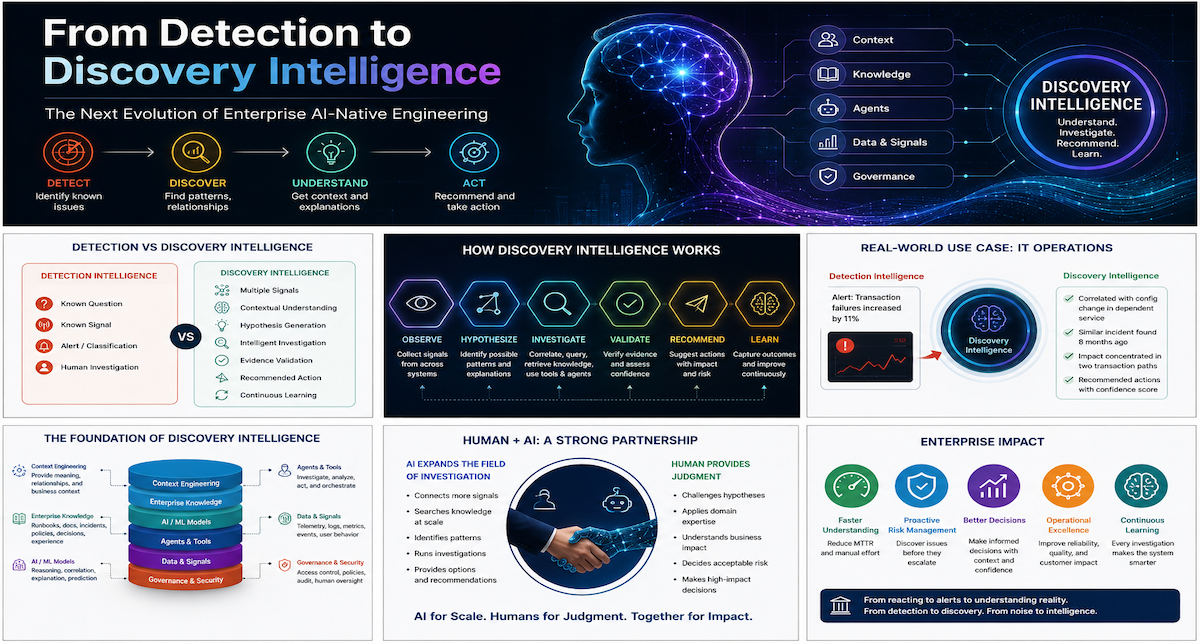
Imagine an enterprise platform where transaction failures increase by 11% over six hours.
A traditional monitoring system detects the increase and raises an alert.
That is detection intelligence.
The next step usually depends on humans. An engineer reviews dashboards. Another team checks the latest deployment. Someone examines infrastructure metrics. A database specialist looks at query performance. An operations lead reviews customer impact.
Eventually, people connect the signals and form a hypothesis.
A discovery-oriented system would approach the situation differently.
It could correlate the increase in transaction failures with a deployment made several hours earlier, a gradual increase in database connection wait time, a traffic shift from one customer segment, a configuration change in a dependent service, and a similar incident that occurred months ago.
Instead of simply saying:
“Failure rate is high.”
the system could provide a much more useful explanation:
“The increase appears correlated with a configuration change in a dependent service. Similar symptoms were observed during an earlier connection-pool saturation incident. Customer impact is concentrated in two transaction paths. Recommend validating connection utilization and reviewing the configuration change before broader escalation.”
That is a different form of intelligence.
The value does not come from detecting one signal. It comes from discovering relationships across signals, context, history, and knowledge.
 EAINE · EAINE proprietary architecture illustration
From Monitoring to Understanding
Most enterprise systems are designed around monitoring.
We define metrics, create thresholds, build dashboards, and configure alerts.
These systems are essential, but they are fundamentally reactive. They tell us when something crosses a boundary we already defined.
Discovery intelligence introduces a different model.
Instead of monitoring only predefined conditions, intelligent systems continuously examine relationships across operational telemetry, enterprise knowledge, historical incidents, business context, user behaviour, system dependencies, policy changes, and external signals.
The objective is not to produce more alerts.
In many cases, the objective should be to produce fewer alerts and more understanding.
Context Becomes Critical
Discovery intelligence cannot operate effectively using isolated signals.
It requires context.
A 10% increase in latency may be insignificant during a low-risk internal workflow and critical during a customer payment transaction.
A sudden increase in authentication failures may indicate an application defect, a security event, or simply a planned migration.
The signal alone does not explain the situation.
Meaning comes from context.
The system needs to understand what business capability is affected, which users are impacted, what changed recently, which systems are related, what happened previously, which policies apply, and what level of risk is acceptable.
This is why Context Engineering becomes foundational.
Detection finds signals. Context gives them meaning. Discovery connects them into an explanation.
Enterprise Knowledge Becomes Operational Intelligence
Most organizations already possess enormous amounts of knowledge.
Architecture documents, runbooks, incident reports, design decisions, operational procedures, customer feedback, policies, historical tickets, and engineering discussions.
The problem is that this knowledge is often fragmented across repositories and difficult to use when decisions need to be made quickly.
Discovery intelligence changes the role of enterprise knowledge.
Knowledge becomes an active part of the reasoning process.
A system investigating a production issue should be able to retrieve relevant historical incidents, understand known dependencies, compare previous resolutions, identify architectural constraints, and relate those findings to the current situation.
This is where enterprise knowledge evolves from documentation into operational intelligence.
Discovery Requires More Than a Better Model
It would be easy to assume that more capable language models will automatically create discovery intelligence.
They will help.
But the model alone is not enough.
A discovery-oriented enterprise system requires multiple capabilities working together: context management, knowledge retrieval, agent orchestration, tool access, real-time data integration, evaluation, governance, observability, and human oversight.
The model provides reasoning capability.
The surrounding system provides trusted information, enterprise boundaries, memory, tools, and accountability.
This is the same architectural shift we are beginning to see across AI-native engineering.
The model is important.
But the model is not the system.
The Role of Agents
Agentic AI makes discovery even more interesting.
An agent does not need to stop after identifying a possible explanation. It can investigate.
One agent may analyse telemetry. Another may search historical incidents. Another may inspect recent code or configuration changes. Another may evaluate business impact.
A coordinating agent may combine those findings and decide whether additional evidence is required.
This creates a different enterprise pattern:
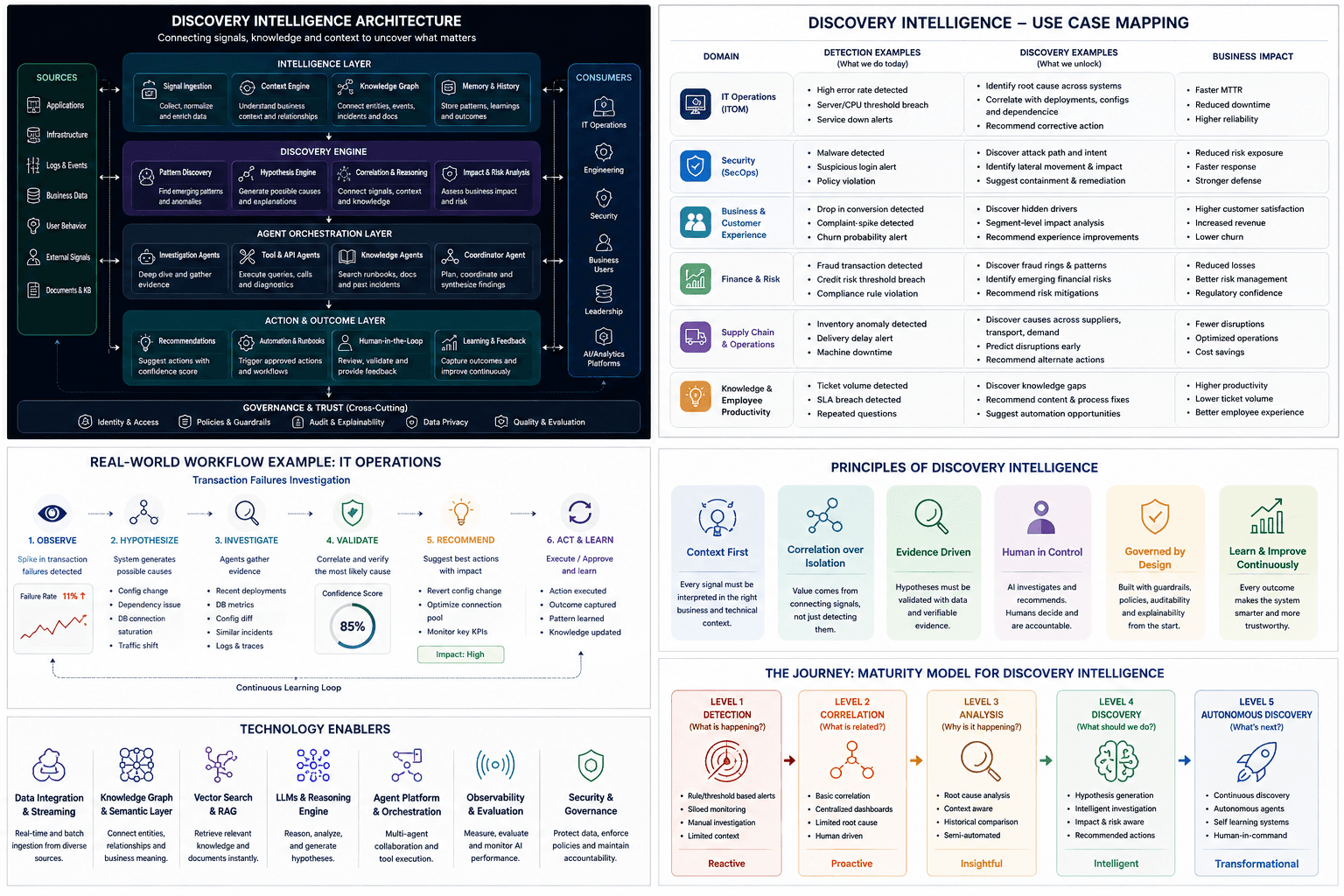
Observe → Hypothesize → Investigate → Validate → Recommend → Learn
Traditional automation usually follows predefined workflows.
Discovery systems can dynamically determine which investigative path is appropriate based on what they learn.
That is powerful.
It is also why governance becomes essential.
Discovery Without Governance Becomes Risk
A system that can investigate, access tools, query sensitive data, and recommend actions introduces new risks.
Not every agent should access every source.
Not every hypothesis should trigger an automated action.
Not every correlation should be treated as causation.
Discovery intelligence therefore needs clear boundaries.
The system should understand which evidence is authoritative, which sources can be accessed, which actions require approval, how confidence is represented, when human review is mandatory, and how decisions are logged and explained.
The goal is not autonomous investigation at any cost.
The goal is governed discovery.
Human Expertise Becomes More Valuable
Discovery intelligence does not eliminate the need for experts.
It changes where their expertise is applied.
Today, specialists often spend significant time gathering information and connecting evidence manually.
AI can reduce that burden.
Humans can then focus on challenging hypotheses, applying domain judgment, understanding business implications, handling ambiguity, deciding acceptable risk, and making high-impact decisions.
In this model, AI expands the field of investigation.
Humans provide judgment.
That is a much stronger partnership than simply asking AI to generate answers.
From Detection Intelligence to Discovery Intelligence
The transition can be summarized simply.
Detection Intelligence
Known question → Known signal → Classification or alert → Human investigation
Discovery Intelligence
Multiple signals → Contextual understanding → Hypothesis generation → Intelligent investigation → Evidence validation → Recommended action → Continuous learning
The first model helps enterprises identify events.
The second helps enterprises understand situations.
That difference is significant.
 EAINE · EAINE proprietary architecture illustration
Implications for Enterprise Architecture
Discovery intelligence requires enterprise architecture to evolve.
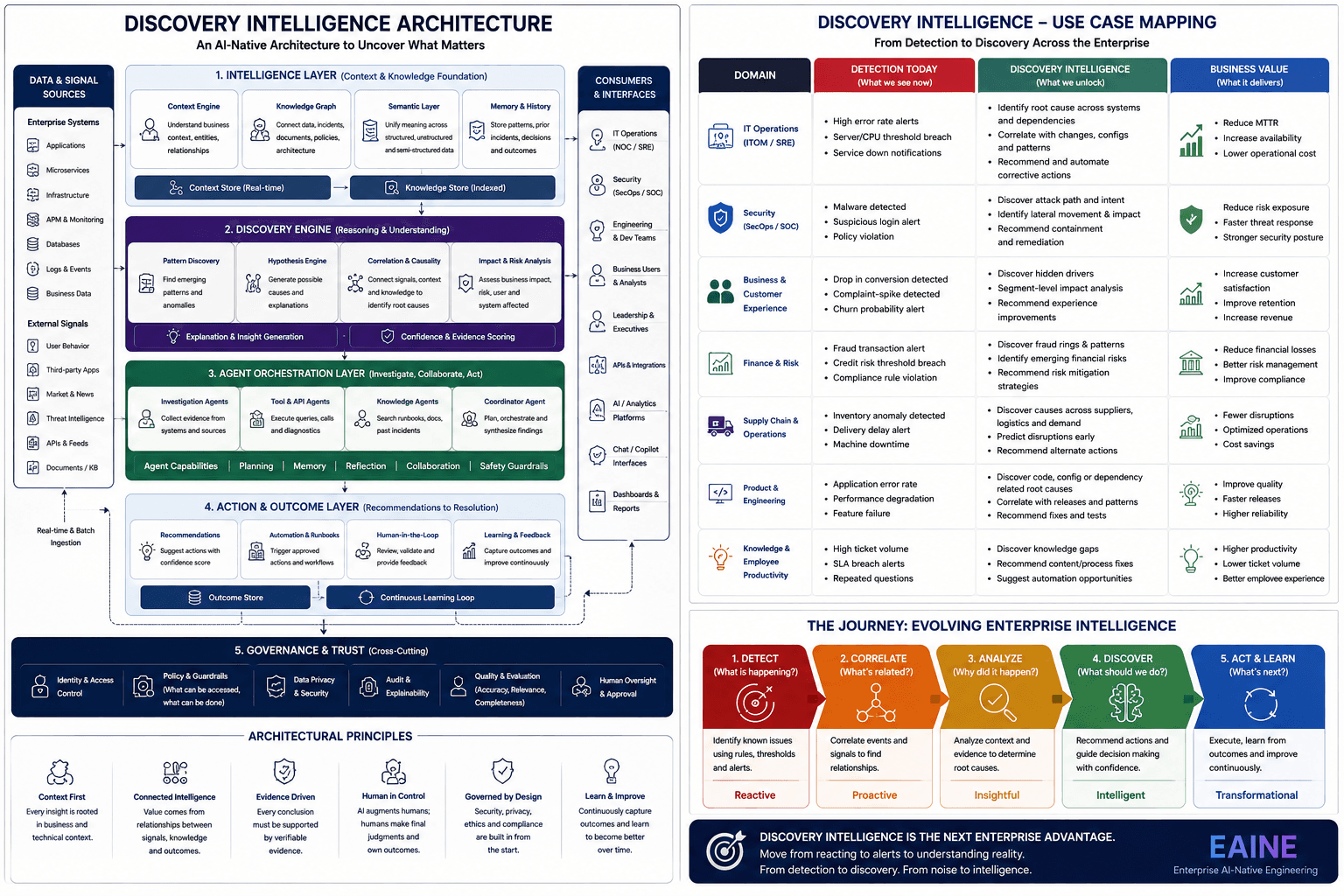
Data cannot remain isolated within individual systems. Knowledge cannot remain passive inside documents. AI cannot operate without identity, policy, evaluation, and observability.
Enterprises will increasingly need an intelligence layer capable of connecting context, knowledge, agents, tools, and operational systems.
That layer must remain governed.
It must understand both technical state and business meaning.
It must also learn from previous outcomes.
This is not simply another analytics capability.
It is the beginning of a different operating model for enterprise intelligence.
Enterprise AI-Native Engineering
This direction is closely connected with the work I have been exploring through Enterprise AI-Native Engineering (EAINE).
AI-native engineering is not only about integrating generative AI into existing applications.
It is about rethinking how intelligent systems are designed, built, evaluated, governed, and operated when reasoning becomes a foundational capability.
Discovery intelligence requires many of those same foundations: Context Engineering, AI-native architecture, enterprise knowledge systems, agent orchestration, continuous evaluation, governance by design, and human-AI collaboration.
The goal is not simply to make enterprise software more intelligent.
It is to make enterprise systems capable of continuously understanding and learning from the environments in which they operate.
Looking Ahead
For decades, enterprises invested heavily in systems of record.
Then came systems of engagement.
More recently, organizations started building systems of intelligence.
The next evolution may be systems of discovery.
Systems that do not merely store information.
Systems that do not simply automate workflows.
Systems that do not only detect predefined events.
But systems that continuously examine context, connect evidence, surface emerging patterns, and help humans understand what they did not yet know to ask.
That is where AI can create a different kind of enterprise advantage.
Conclusion
Detection intelligence answers an important question:
“Did something happen?”
Discovery intelligence goes further:
“What is happening, why does it matter, and what should we investigate or do next?”
That shift changes the role of AI from a detection engine into a partner in enterprise understanding.
The organizations that build this capability responsibly will not only respond faster to known problems.
They may begin discovering risks, opportunities, and patterns before those questions are obvious to everyone else.
And that may become one of the defining capabilities of the AI-native enterprise.
What do you think will create more enterprise value over the next few years: improving our ability to detect known problems, or building systems capable of discovering the problems and opportunities we have not yet defined?
#ArtificialIntelligence #EnterpriseAI #AIEngineering #AgenticAI #EnterpriseArchitecture #SoftwareEngineering #EAINE
References
- Continuous improvement for AI systemsarXivAccessed August 10, 2026
- Observability patterns for adaptive operationsarXivAccessed August 10, 2026
- From incident detection to system discoveryarXivAccessed August 10, 2026
- Enterprise operations telemetry for machine agentsNatureAccessed August 10, 2026
- AI and feedback loops in production environmentsarXivAccessed August 10, 2026
Publication detailsVersion 1.2.0 · Updated August 11, 2026 · Editorially approved
- v1.2.0
Restored the three original Discovery Intelligence publication visuals.
- v1.1.0
Restored the complete original LinkedIn and Medium article with its three-image editorial sequence.
- v1.0.0
Published a draft-adapted Part 4 for the EAINE Foundation Series.
Public reviewers: Editorial Review Team, Editorial Review Team