
In this article 23 sections
Enterprise teams are now asking the wrong question.
They are still trying to choose the “best AI model,” and in some cases, the “best prompt.”
The real question is:
What architecture will make AI useful, safe, and continuously reliable in enterprise workflows?
Executive Summary
This article is the structural follow-on to Part 1 of the EAINE Foundation Series.
If Part 1 argued that context is the next differentiator, this article argues that context without architecture is not enough.
An AI model can generate text, summarize data, write code, and make recommendations.
But enterprise AI only becomes practical when the surrounding system supplies:
- reliable context
- business constraints
- guardrails
- governance
- memory
- feedback loops
- observable action trails
In short:
A model is a capability. A system is an engineered ecosystem.
Organizations win when they build the second, not just the first.
AI model ≠ AI system
Most enterprise AI pilots fail after the demo phase.
They start with a model.
They connect APIs.
They add a UI.
Then they discover:
- inconsistent outputs across similar requests,
- fragile retrieval paths,
- unsafe actions in edge cases,
- slow recovery from failures,
- no clear ownership of data quality,
- no measurable improvement over time.
That is not a model problem.
That is a system design problem.
The model is often the simplest piece of the stack.
The difficult part is orchestrating:
- where context comes from,
- how it is scored,
- how it is applied,
- and how output is governed.
Why enterprises need architecture, not just models
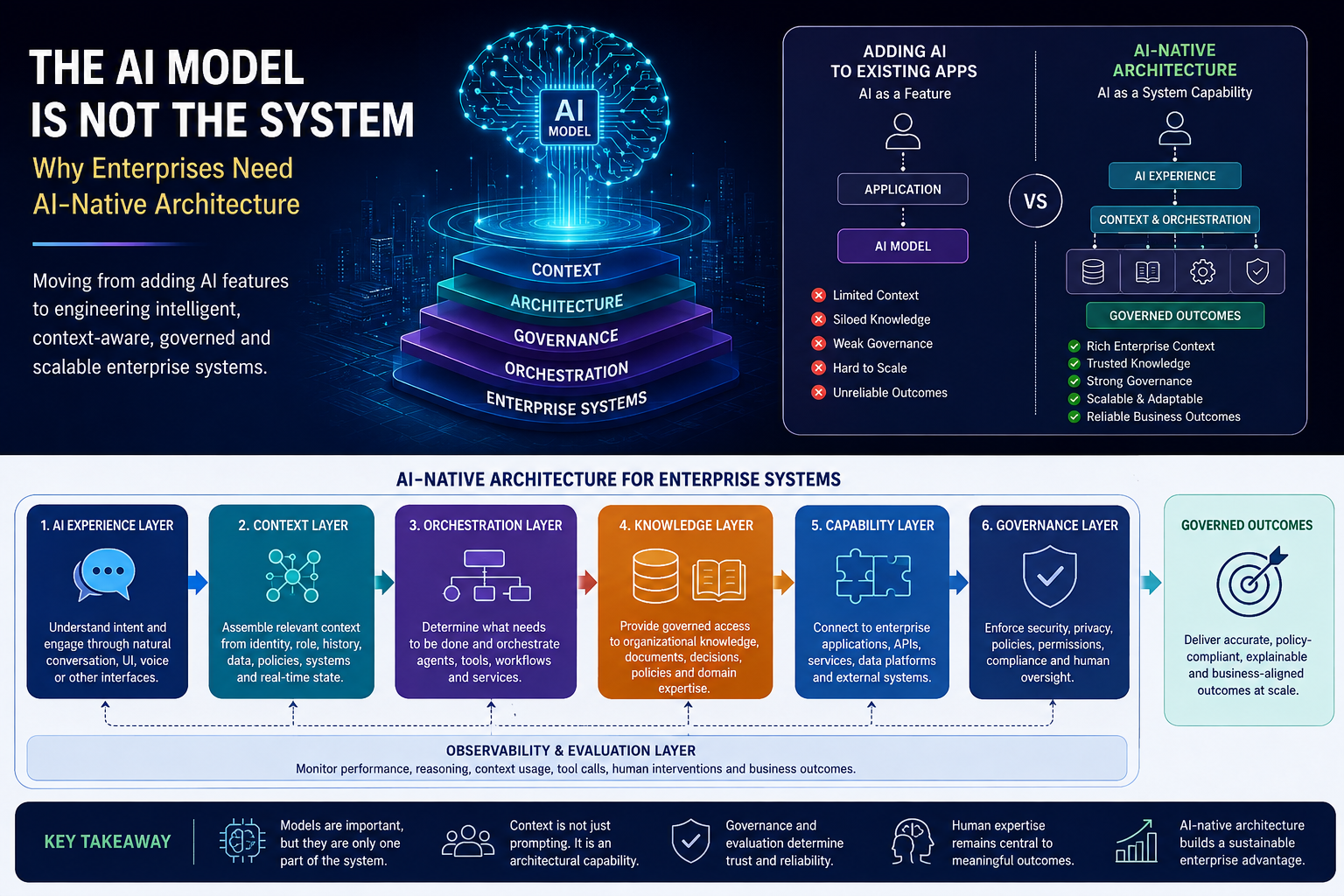
In the classic view, teams treat AI like an add-on:
This looks neat in architecture diagrams, but it breaks quickly in live operations.
Enterprise software is not solved by a single prompt-to-response pipeline.
It requires a layered architecture where AI components participate in workflows with controls.
At scale, the architecture must answer:
- Which tenant, team, or role is making the request?
- What does “correct” mean for this decision?
- Which data sources are fresh enough today?
- What constraints (policy, compliance, risk) apply now?
- What action is permissible?
- How should the result be reviewed or escalated?
- How does this run improve next time?
Without these layers, AI remains a tool. With them, AI becomes part of the organization.
The AI-native architecture baseline
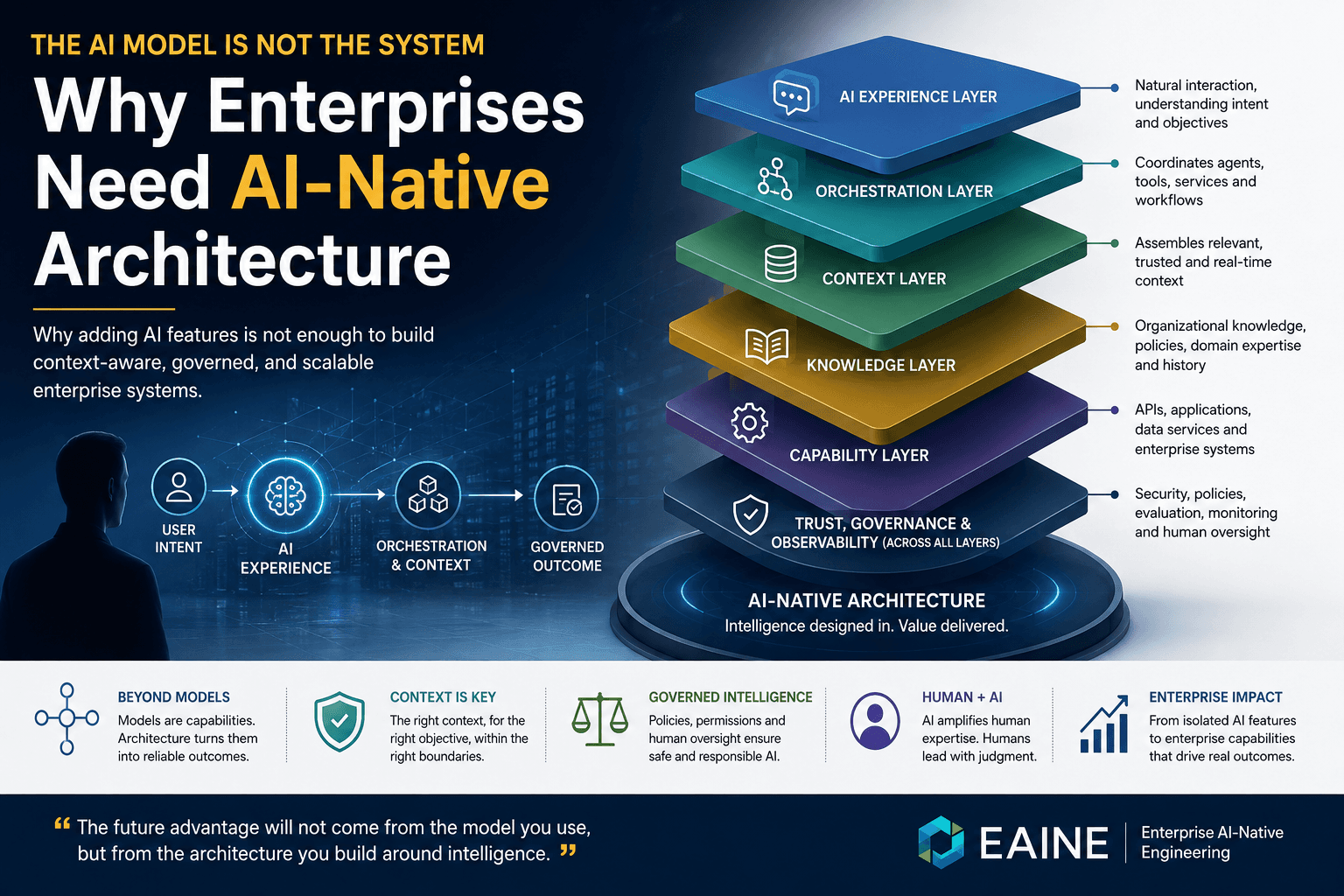
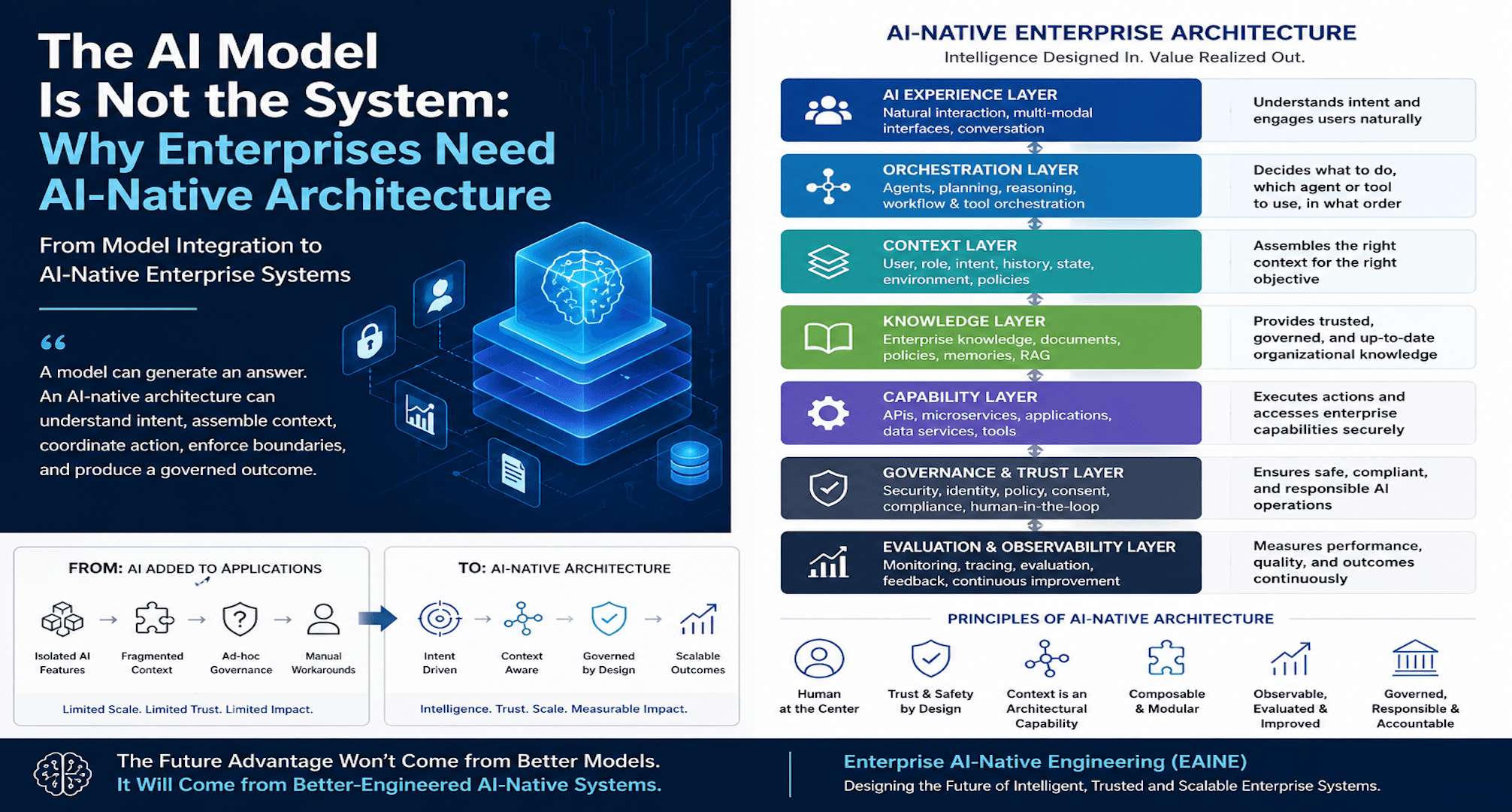
A practical enterprise AI-native stack usually contains these layers:
1) Experience layer
Channels, copilots, and workflow touchpoints where users interact.
This layer converts business intent into structured requests.
2) Orchestration layer
Agent routing and decision routing.
This layer decides whether to retrieve, compute, escalate, or call tools.
3) Reasoning layer
Policy-aware planning, decomposition, confidence estimation, and tool selection.
Reasoning logic belongs to products and services, not hidden inside prompts alone.
4) Context layer
Knowledge retrieval, memory retrieval, user context, historical state.
This is where most enterprise AI failure risk is reduced or amplified.
5) Knowledge layer
Internal documentation, runbooks, API schemas, data definitions, taxonomy, and domain logic.
When this layer is weak, model outputs become generic and brittle.
6) Governance and control layer
Policy filters, approval flows, audit trails, red-team rules, and cost/safety controls.
This layer protects business outcomes and supports compliance.
 EAINE · EAINE proprietary architecture illustration
Each layer exists to prevent “clever output” from becoming “bad action.”
A minimal operating loop for AI-native systems
Reliable systems repeat the same closed loop:
- Observe operational context and request intent.
- Understand with policy, history, and source confidence.
- Reason over possible actions.
- Act using controlled tools or workflows.
- Evaluate outcomes and cost.
- Learn and refine retrieval and orchestration policies.
 EAINE · EAINE proprietary architecture illustration
This loop is the difference between “AI feature” and “AI system.”
What goes wrong when architecture is skipped
Three common anti-patterns repeat across verticals:
Anti-pattern 1: Prompt-first design
Teams keep improving prompts and model calls but never improve context flow.
Effect: lower trust, rising review burden, inconsistent decisions.
Anti-pattern 2: Tooling-first without controls
Tool calls are added quickly, but tool access policies and safety boundaries are not.
Effect: accidental policy violations, unauthorized actions, or silent failures.
Anti-pattern 3: No feedback ownership
Teams launch AI workflows and never close the loop.
Effect: no measurable improvement, hidden regressions, model drift not detected.
How to move from model pilots to AI-native architecture
The migration is usually staged:
Phase 1: Define enterprise context contracts
Define what each request should include before model invocation:
- user role
- objective
- source context
- policy envelope
- confidence threshold
Phase 2: Add orchestration and governance layers
Create explicit routing:
- retrieval path,
- escalation policy,
- action scope,
- fallback actions,
- post-action evaluation.
Phase 3: Build evaluation-by-default
Every AI decision route needs metrics:
- precision of answer quality
- policy breach rate
- escalation rate
- mean context recency
- human override frequency
- time to correction
Phase 4: Treat memory as infrastructure
Store decision traces, context lineage, and learning signals.
Use them to refine future routing, retrieval confidence, and fallback logic.
EAINE perspective: architecture is the new AI advantage
The architecture mindset is not “more engineering for engineering’s sake.”
It is:
- predictable behavior under uncertainty,
- safer autonomy,
- faster business decision cycles,
- auditable growth.
In EAINE, we argue that modern enterprise intelligence is earned through five disciplines:
- Context authority
- Agent orchestration
- Policy-aware reasoning
- Memory and evidence
- Continuous evaluation
When these become part of your product architecture, AI stops being a pilot and becomes a dependable layer of enterprise operations.
Conclusion
The AI model is now a commodity in many enterprise contexts.
What is not commodity is the architecture that surrounds it.
Firms that focus only on model selection will remain dependent on luck, manual fixes, and expensive post-hoc governance.
Firms that design AI-native architecture will move faster, safer, and with measurable quality over time.
This is the core shift for enterprise AI in the next cycle.
Continue EAINE Foundation Series
References
- Artificial Intelligence Risk Management Framework (AI RMF 1.0)National Institute of Standards and TechnologyAccessed August 10, 2026
- Artificial Intelligence Risk Management Framework: Generative Artificial Intelligence ProfileNational Institute of Standards and TechnologyAccessed August 10, 2026
- Hidden Technical Debt in Machine Learning SystemsGoogle ResearchAccessed August 10, 2026
- Model Cards for Model ReportingFAT* 2019Accessed August 10, 2026
- ReAct: Synergizing Reasoning and Acting in Language ModelsICLR 2023Accessed August 10, 2026
Publication detailsVersion 1.3.0 · Updated August 11, 2026 · Editorially approved
- v1.3.0
Restored the three original Model-versus-System publication visuals.
- v1.2.0
Restored the original externally published narrative and its focused three-image editorial sequence.
- v1.1.0
Expanded the architecture argument, corrected references, replaced placeholder diagrams, and added practical decision guidance.
- v1.0.0
Published Part 2 of the EAINE Foundation Series.