

In this article 8 sections
Enterprise AI is becoming more capable, but capability is not the same as understanding the situation.
A model may know how to analyse a contract, explain a policy, or recommend an action. It does not automatically know which policy version applies, whether the user has authority, what has already happened in the workflow, or which source should be trusted when records disagree.
These failures are often blamed on the model. Many are actually failures of context.
The next foundation of enterprise AI is therefore not another prompt or a larger context window. It is a governed context layer: an architectural capability that assembles the minimum trusted representation of the situation before AI reasons or acts.
Context is not simply more information
Retrieval-augmented generation demonstrated the value of connecting models to external knowledge 1. But retrieval answers only one question: What information appears relevant?
An enterprise system must answer more:
- Is this source authoritative for the current decision?
- Is the information current and complete?
- May this user access it for this purpose?
- What happens when trusted sources conflict?
- Which evidence must be preserved for review?
Longer context windows do not resolve these questions. Research has also shown that models may use information unevenly across long inputs 2. More content can increase cost, expose unnecessary data, and allow important evidence to disappear inside noise.
The objective is not maximum context. It is sufficient, trusted, purpose-bound context.
The four responsibilities of a context layer
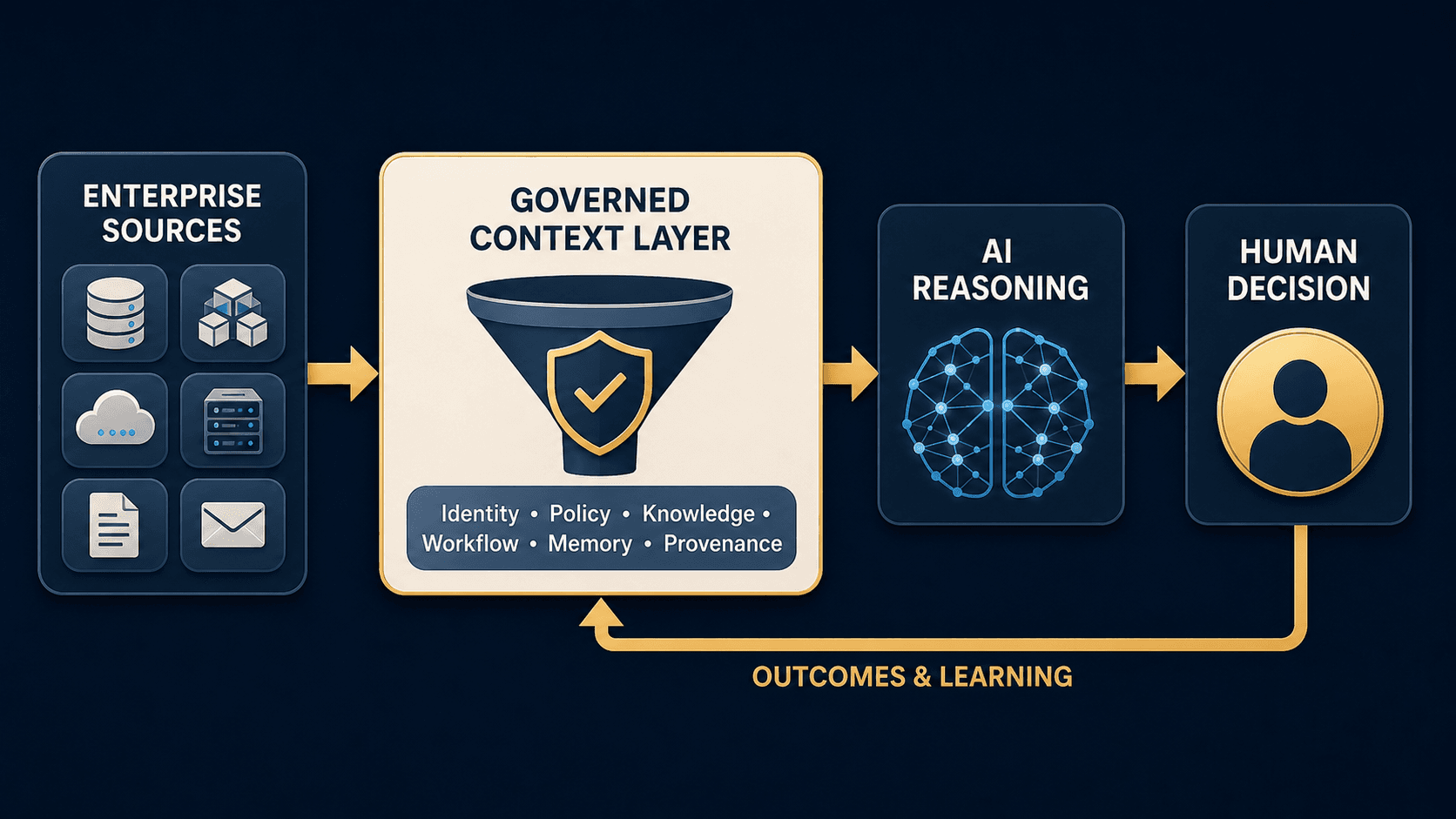 EAINE — Context Layer Architecture · Original AI-assisted visual; editorially reviewed by EAINE
1. Understand the situation
The layer identifies the actor, purpose, task, channel, and current workflow state. It distinguishes a request for information from a request to take action.
2. Select authorized evidence
It retrieves from approved sources and applies identity, entitlement, freshness, and source-authority rules before sensitive information reaches the model.
3. Structure context for reasoning
It prioritizes material facts, separates trusted instructions from untrusted content, represents conflicts, and makes missing evidence visible. The model receives a decision-ready package—not an indiscriminate document dump.
4. Preserve accountability
It records which sources, versions, policies, and approvals shaped the result. This makes decisions reconstructable and creates governed feedback for improvement. NIST's AI Risk Management Framework similarly treats context and lifecycle governance as essential to managing AI risk 3, while provenance standards such as PROV-O show how information can remain traceable to its origin and transformation 4.
A simple enterprise test
Imagine an employee asks:
“Can I approve this supplier contract?”
A model-first system may retrieve the procurement policy and summarize the approval threshold.
A context-aware system also establishes the employee's current authority, the contracting legal entity, contract value and risk class, applicable policy version, prior exceptions, and whether legal or security review is complete. It can then provide an answer that fits the actual situation—or explain precisely what is missing.
The difference is not a better paragraph. It is a better decision boundary.
Three questions for the next architecture review
Before adding another model, agent, or source, ask:
- What must the system know to understand this situation?
- What is it allowed to know and do for this user and purpose?
- Can we reconstruct the evidence and authority behind the result?
If the architecture cannot answer these questions consistently, the AI capability is sitting on an unstable foundation.
Better models will continue to matter. But as they become more capable—and more able to influence enterprise decisions—the quality of the context around them matters even more.
The model provides reasoning capability.
The context layer makes that capability usable, governable, and accountable.
References
- Retrieval-Augmented Generation for Knowledge-Intensive NLP TasksLewis et al.Accessed August 11, 2026
- Lost in the Middle: How Language Models Use Long ContextsLiu et al.Accessed August 11, 2026
- Artificial Intelligence Risk Management FrameworkNational Institute of Standards and TechnologyAccessed August 11, 2026
- PROV-O: The PROV OntologyWorld Wide Web ConsortiumAccessed August 11, 2026
Publication detailsVersion 1.0.0 · Updated August 31, 2026 · Editorially approved
- v1.0.0
Approved and published the Context Layer article with complete architecture visuals, verified citations, and sharing metadata.
- v0.4.0
Reframed the Monday article as a concise practitioner edition focused on four context-layer responsibilities.
- v0.3.0
Simplified the context architecture into four readable stages and one outcomes feedback loop.
- v0.2.0
Added original hero and governed context lifecycle architecture illustrations.
- v0.1.0
Created the complete Monday article draft from the locked EAINE editorial plan.