
In this article 14 sections
Executive summary
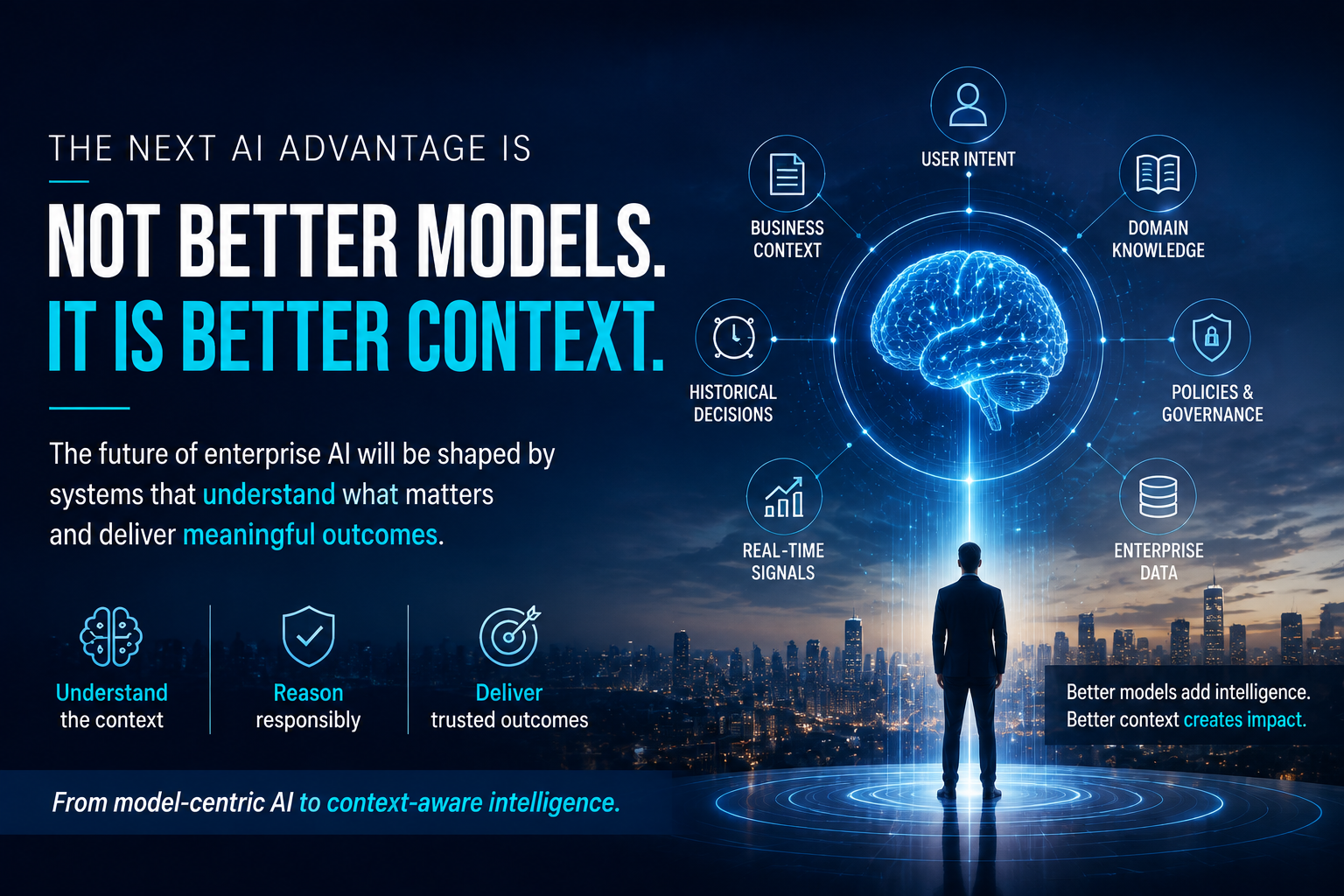
AI quality in enterprises is limited less by model ability and more by context fidelity. This essay reframes model-first thinking into context-first engineering and shows how context is an architectural layer that requires ownership, validation, and governance.
The baseline mistake
Part 1 argues for a new competitive edge in enterprise AI. The old sequence—choose a model, tune a prompt, ship a feature—was useful during experimentation.
At enterprise scale, AI quality becomes a systems problem: the same model can produce inconsistent outcomes when context is missing, stale, or unsafe.
Context engineering becomes architecture
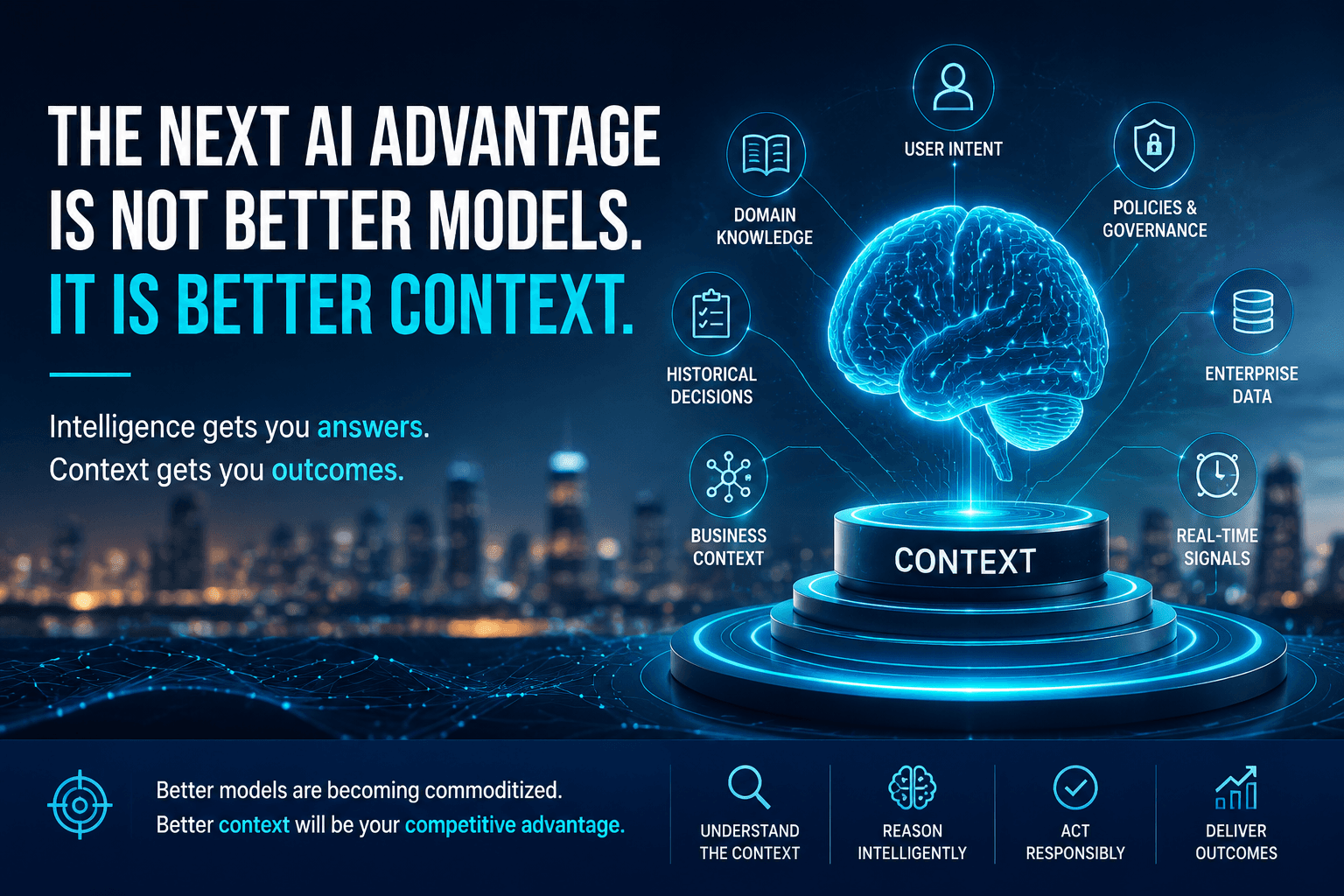
Context engineering is the engineering of what the model receives and why. It includes:
- intent and role state,
- policy and safety constraints,
- source freshness and confidence,
- workflow status and handoff rules,
- user and system feedback.
 EAINE · EAINE proprietary architecture illustration
Why prompts alone are no longer enough
A good prompt can improve expression. It cannot fix weak context lineage, weak governance boundaries, or weak feedback.
 EAINE · EAINE proprietary architecture illustration
An AI-native baseline architecture
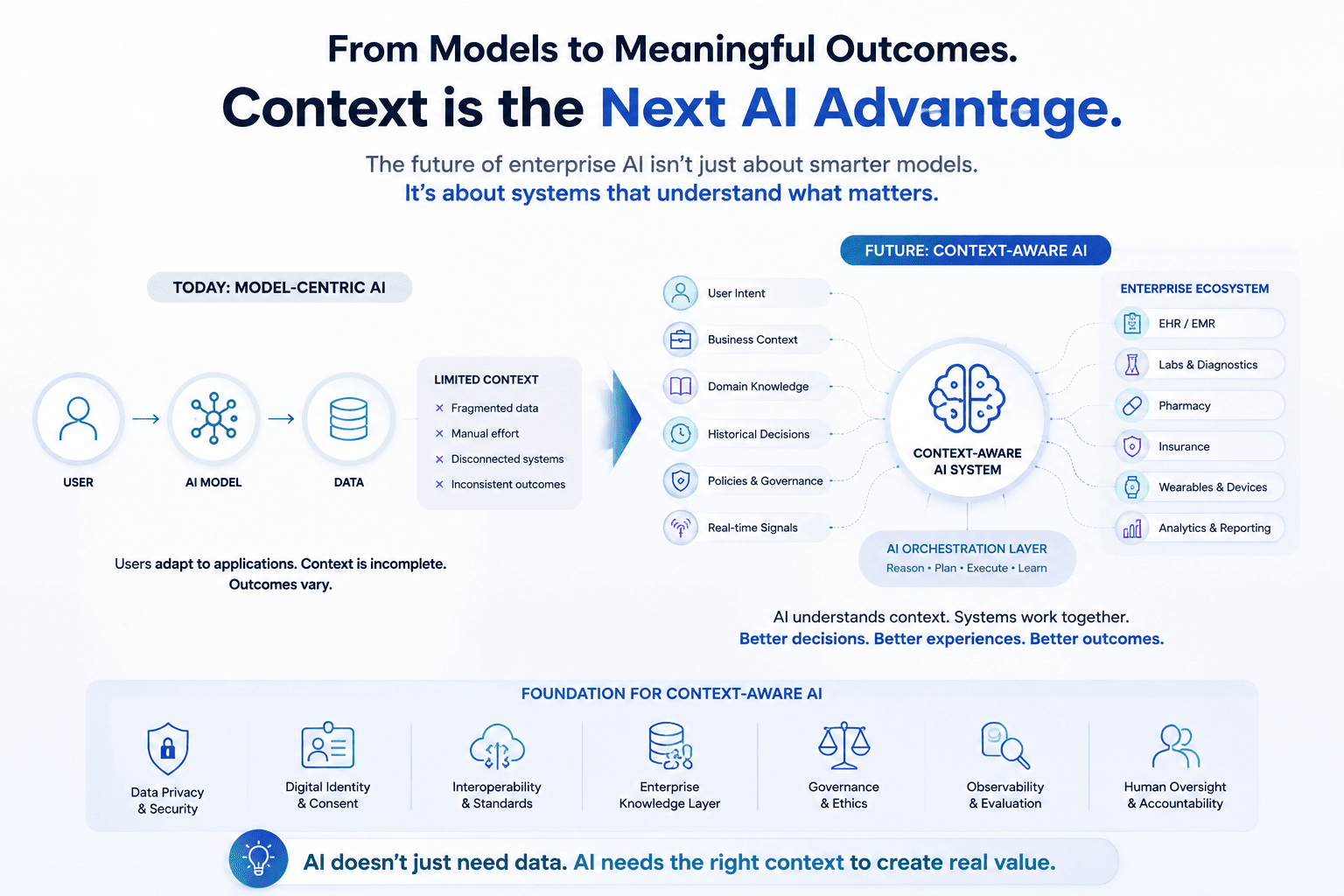
A robust architecture usually includes:
- Experience layer for request capture.
- Orchestration and routing for task decomposition.
- Reasoning layer for policy-aware planning.
- Context layer for retrieval, ranking, and conflict resolution.
- Knowledge and memory layer for enterprise continuity.
- Governance and control layer for auditability and escalation.
Why this is faster and safer
The same architecture also reduces model churn. Teams spend less time re-tuning prompts and more time improving context quality and feedback loops.
90-day implementation sequence
First 30 days
- Define context boundaries and owners.
- Build a canonical context schema per workflow.
- Add source freshness checks.
Next 30 days
- Add conflict resolution, dedupe, and validation rules.
- Add human override, escalation, and escalation audit.
- Introduce context quality metrics.
Final 30 days
- Route high-confidence work to controlled automation.
- Add continuous learning from overrides and corrections.
- Standardize context quality governance.
EAINE perspective
If context is not explicit, enterprise AI outcomes become non-repeatable. EAINE architecture requires teams to treat context design as a first-class engineering responsibility, with the same discipline as API design, security controls, and release gates.
Key takeaways
- Good models are a multiplier; weak context is a force multiplier for risk.
- Context quality should be monitored like latency and reliability.
- Teams gain better outcomes by adding context ownership, freshness checks, and policy-aware routing before model fine-tuning.
- Reviewability is the foundation for enterprise trust in AI systems.
Continue the Foundation Series
References
References
- Retrieval-Augmented Generation for Knowledge-Intensive NLP TasksLewis et alAccessed August 10, 2026
- Chain-of-Thought Prompting Elicits Reasoning in Large Language ModelsWei et alAccessed August 10, 2026
- GPT-4 Technical ReportOpenAIAccessed August 10, 2026
- OpenAI API ReferenceOpenAIAccessed August 10, 2026
- Retrieval-augmented generation on Google CloudGoogleAccessed August 10, 2026
Publication detailsVersion 1.1.0 · Updated August 11, 2026 · Editorially approved
- v1.1.0
Restored the three original Context article visuals and their accessible publication metadata.
- v1.0.0
Published the finalized Part 1 article for the Foundation Series.
Public reviewers: Editorial Review Team, Editorial Review Team