
In this article 16 sections
Picture a monthly performance review. Engineering reports that the AI agent's cost per response has fallen. The customer-service lead points to cases that were reopened. Finance asks why staff still spend time fixing answers the dashboard marked as complete.
This is an illustrative meeting, but the tension is familiar. Each team is measuring something real. None is measuring the whole result.
A customer does not care how many tokens were consumed while solving a problem. They care whether the problem was resolved correctly. The employee reviewing the work cares whether an apparent completion has created another task. The business leader needs to know whether the system is genuinely saving effort or simply moving it elsewhere.
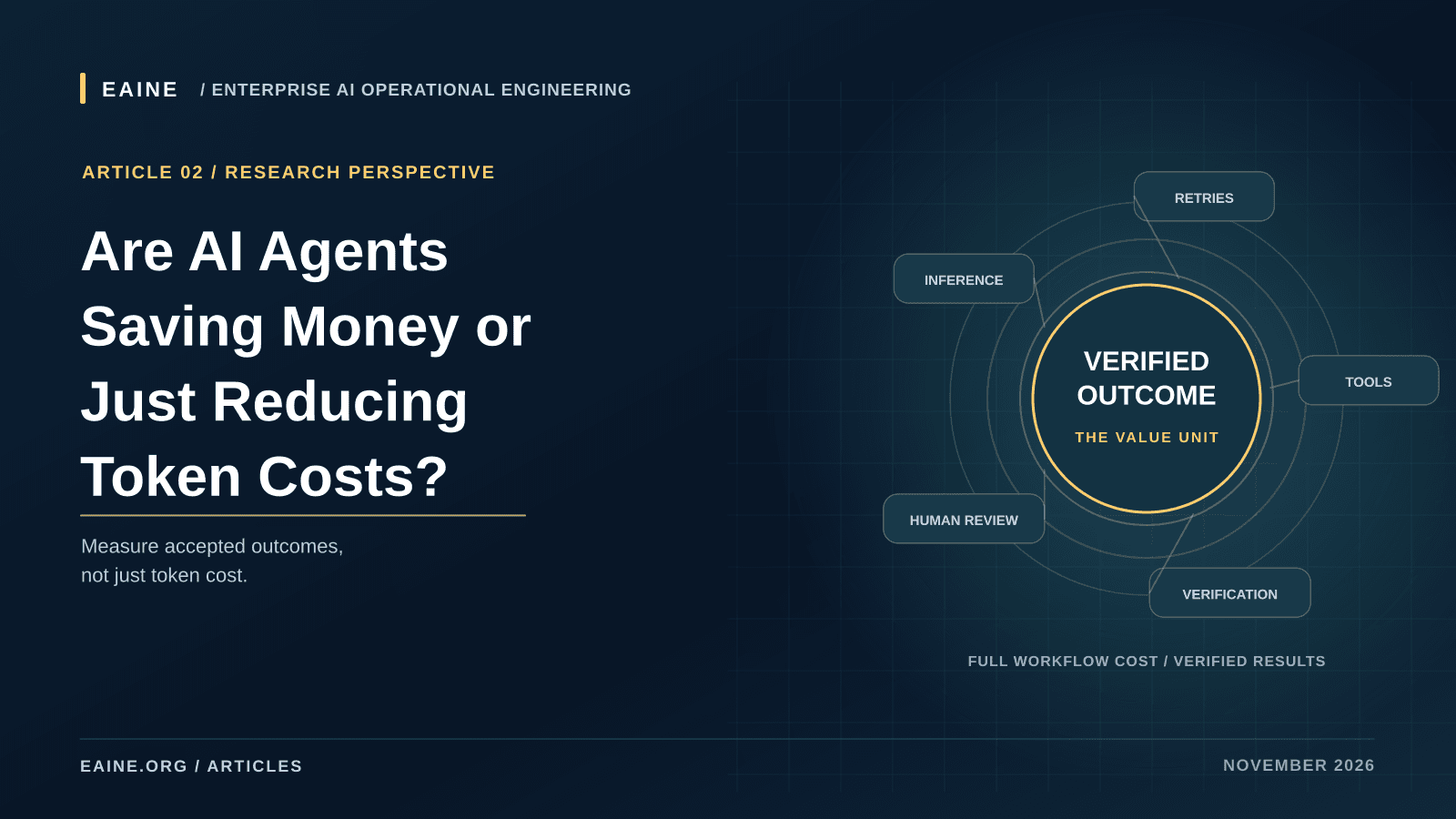
An AI agent can become cheaper per request while becoming more expensive per verified business outcome.
That is the difference between celebrating activity and understanding value.
The agent economics problem is becoming visible
Gartner's October 26, 2026 analysis, Agentic AI's Next Hurdle Is Cost, Not Capability, reports that fewer than 10% of agentic AI deployments in a review of nearly 1,000 case studies were delivering robust return on investment 1.
Gartner also forecasts that inference cost per agentic workflow could increase more than fivefold through 2028. These are analyst findings and forecasts, not measured results from EAINE deployments. They do not imply that every model call will become more expensive or that all agentic systems are economically unsustainable.
The larger point is that reasoning-intensive workflows introduce variable execution paths that conventional application cost metrics often miss.
An agent may plan, retrieve, reason, delegate, invoke tools, wait, retry, validate an answer, request human help and generate remediation work. Each step consumes resources, and not every path delivers an accepted result.
Tokens are a cost input, not the business outcome
Imagine an agent investigating a payment discrepancy. Its workflow could include identity verification, retrieving transaction records, policy lookup, reconciliation, exception handling, response verification and recording evidence.
The same business request may generate multiple model invocations, database reads and API calls. A failed attempt may consume most of these resources without completing the work. If a person must correct the result, labor and rework remain part of the economic picture.
A model-pricing dashboard answers: How much did inference consume?
An operational economics system must also answer: What did we spend to produce a result the business can accept and defend?
What the support manager sees that a token dashboard misses
A case marked “resolved” may come back the next day because the customer received an incomplete answer. A human reviewer may spend ten minutes correcting an agent's five-second response. A retry may look like progress in a trace but deliver no additional customer value.
These are not edge considerations for the people running the service. They determine queue length, workload, customer trust and whether teams believe the automation is helping.
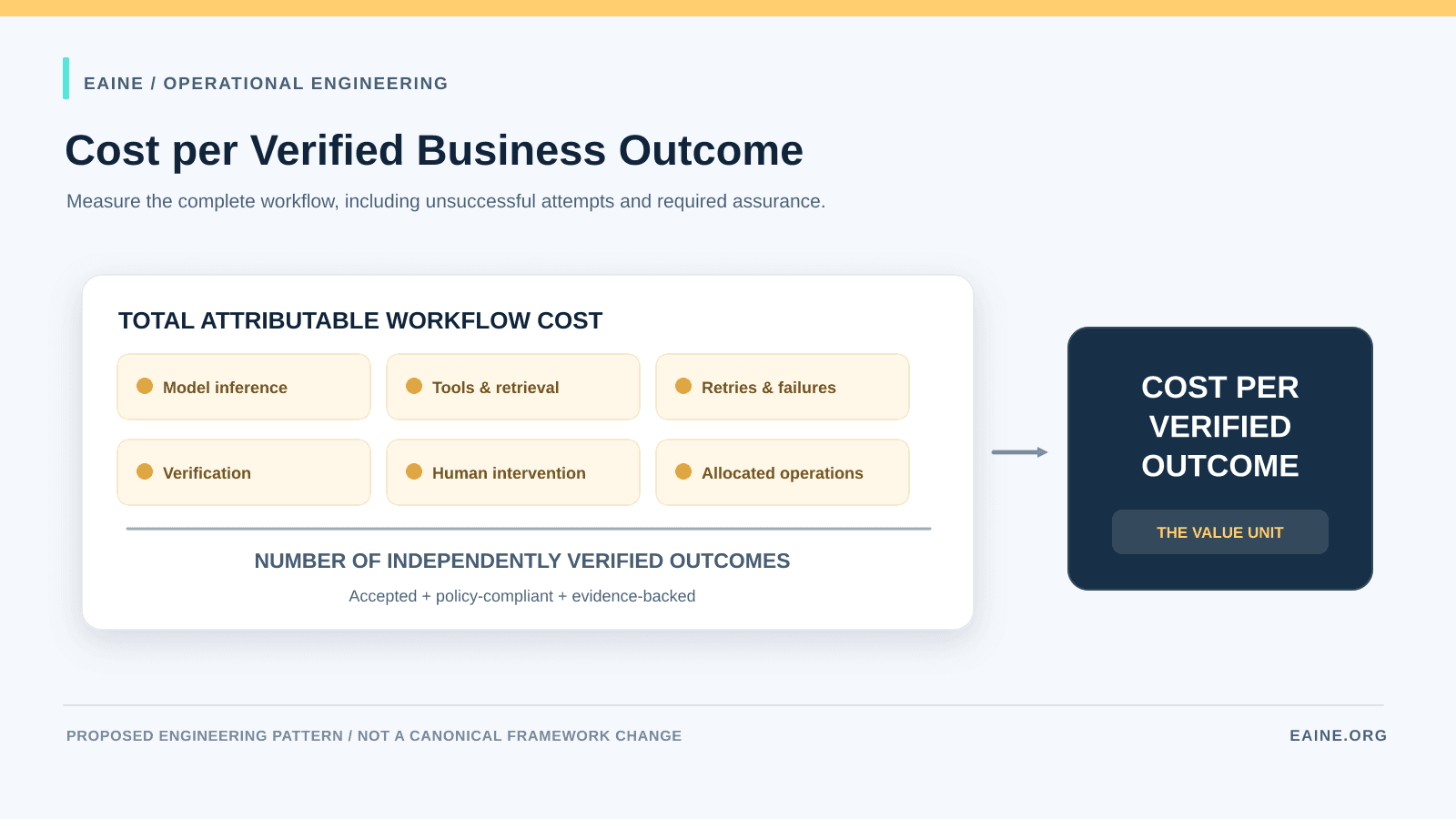
The economic unit therefore needs to be an accepted business outcome, with failed attempts and necessary human intervention charged to the work that caused them.
The core measure: cost per verified outcome
 EAINE Publications · Original EAINE editorial illustration. Proposed pattern, not an approved or certified framework control.
Figure 1. Measuring the complete cost of independently accepted outcomes prevents low per-request token prices from hiding retries, rework and human intervention.
As an engineering research candidate, EAINE proposes the following measurement:
Cost per Verified Outcome = Total Attributable Workflow Cost / Number of Independently Verified Completed Outcomes
The numerator should include relevant costs incurred for the workload during a defined period:
- Inference and reasoning.
- Retrieval, storage and context processing.
- Tool calls and external services.
- Orchestration and attributable infrastructure.
- Retries, timeouts and failed attempts.
- Automated evaluation and independent verification.
- Human review, intervention and escalation.
- Attributable correction and remediation.
- Explicitly allocated shared operating costs.
The denominator must count unique accepted business outcomes, not model responses, individual attempts or successful API returns.
An accepted result should satisfy documented business acceptance criteria and required policy checks. Costs and outcomes must use consistent workflow identifiers and measurement windows. Financial allocation rules should be documented so that calculations can be reconciled and compared over time.
A worked example
Assume two hypothetical customer support agents each receive 10,000 requests in a month.
| Measure | Agent A | Agent B |
|---|---|---|
| Requests received | 10,000 | 10,000 |
| Attributable operating cost | ₹2,00,000 | ₹2,40,000 |
| Verified completed outcomes | 6,000 | 9,000 |
| Cost per verified outcome | ₹33.33 | ₹26.67 |
| Verified completion rate | 60% | 90% |
Agent B has the larger total bill. Yet it produces more accepted outcomes at a lower unit cost. Agent A appears cheaper only if leadership ignores the amount of useful work completed.
These numbers are hypothetical calculations, not industry benchmarks or observed EAINE performance.
The same distinction applies to attempts versus outcomes. Retrying a failed request five times should not inflate the number of business tasks accomplished.
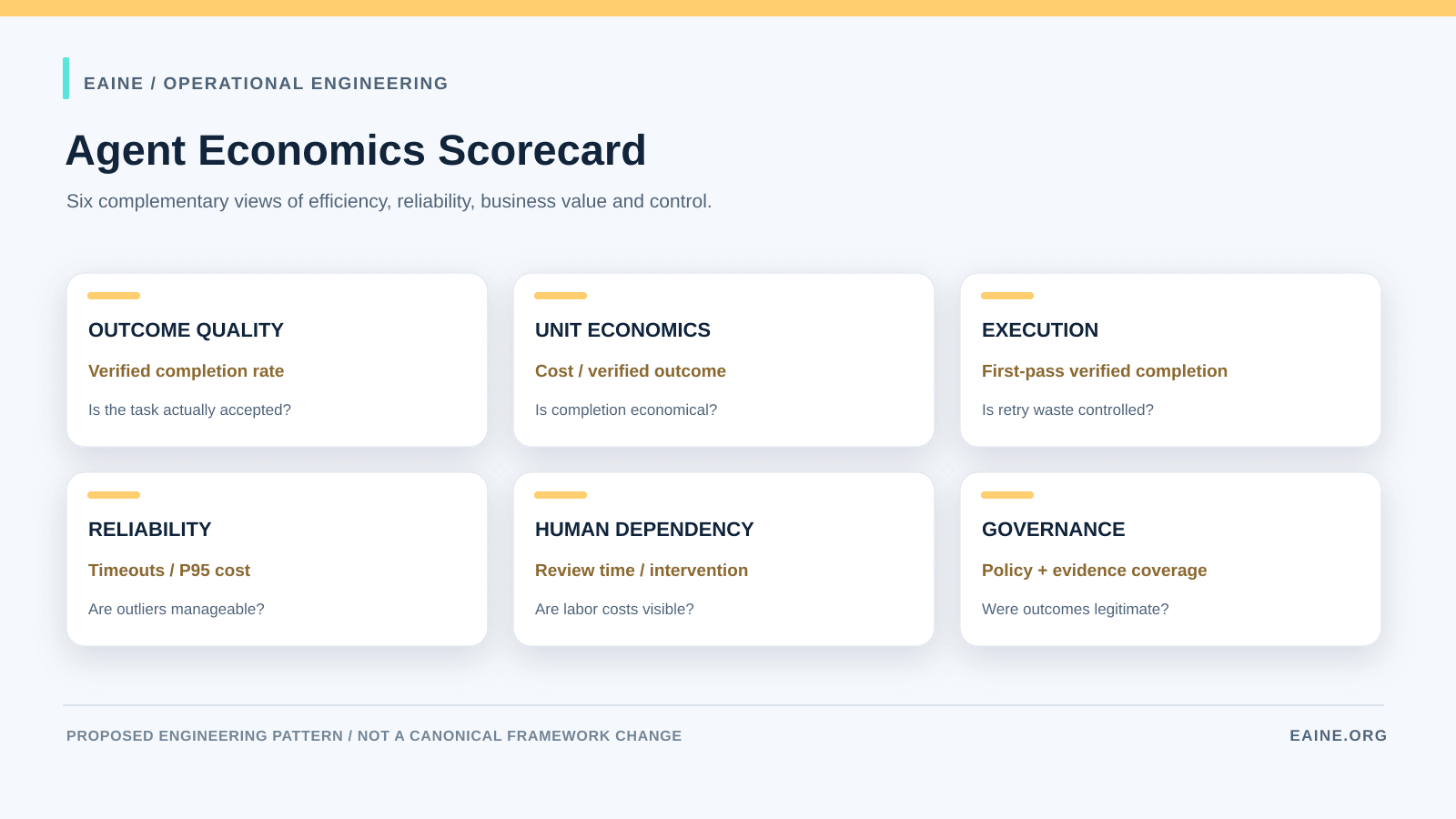
Proposed EAINE Agent Economics Scorecard
 EAINE Publications · Original EAINE editorial illustration. Proposed pattern, not an approved or certified framework control.
Figure 2. The scorecard connects engineering telemetry with business acceptance and cost. Its dimensions are editorial candidates requiring real-workflow validation.
The proposed scorecard links technical execution to business value while keeping quality and governance visible.
| Dimension | Candidate metric | What leadership can decide |
|---|---|---|
| Quality | Verified completion rate | Are accepted results actually increasing? |
| Unit economics | Cost per verified outcome | Is scaling economically sensible? |
| Execution | First-pass verified completion | How much paid work is repeated? |
| Human dependency | Intervention rate and review minutes | Is effort reduced or moved elsewhere? |
| Reliability | Retry, timeout and failure rates | Which defects generate avoidable cost? |
| Tail behavior | P95 cost and duration per workflow | Are expensive outliers controlled? |
| Business value | Incremental verified value against a baseline | Is there a credible business benefit? |
| Governance | Compliance and evidence completeness | Can results be justified and audited? |
No single number is sufficient. A system that cuts costs by skipping mandatory verification has not demonstrated genuine efficiency. An agent that acts quickly without authorization has not created legitimate business value.
The measurement architecture
A useful production design can follow this logical flow:
Business Intent → Correlated Workflow Execution → Model and Tool Telemetry → Outcome Verification → Cost Attribution → Value Assessment → Engineering Feedback
Every unique business request needs a durable identifier connecting model usage, tool execution, retries, human actions, verification and the final accepted result.
Provider bills and cloud costs can be normalized using approaches such as the FinOps Open Cost and Usage Specification, or FOCUS 2. OpenTelemetry's generative AI semantic conventions offer useful telemetry vocabulary 3.
Neither billing normalization nor tracing establishes business value by itself. Application-level correlation and independent outcome verification are still necessary.
Five engineering decisions that change agent economics
1. Match model capability to task complexity
Simple classification or deterministic work should not automatically use the most expensive reasoning path. Complex work may require stronger reasoning and verification. Evaluate routing choices against verified outcomes, risk and reliability, rather than token price alone.
2. Bound execution
Set explicit limits for retries, model calls, tool invocations, wall-clock time and spending. Repeated reasoning without progress should be handled as an operational failure condition.
3. Govern context size
Loading every document, historical memory and verbose tool response into each request may add cost and contradictory evidence. Select context by authorization, applicability and usefulness.
4. Scale verification to risk
Routine reversible work may support lightweight automated checks. Consequential or irreversible actions need stronger evidence and sometimes authorized human approval. Mandatory controls must not be bypassed to reduce cost.
5. Diagnose expensive failures
Investigate high-cost traces for poor task decomposition, weak retrieval, ineffective routing, repeated reasoning, unreliable tools and unnecessary escalation. Measure whether a correction improves accepted results before standardizing it.
Questions for CTOs, CIOs and CFOs
Before expanding an agentic initiative, establish five facts:
- What exact business outcome is the agent authorized to produce?
- What independent evidence proves the outcome was achieved?
- What is the complete attributable cost, including failed work and intervention?
- What credible human or conventional-automation baseline is used for comparison?
- Does the benefit remain positive after reliability, governance and remediation costs?
Cost savings, capacity gains, risk reduction and incremental revenue are different forms of value. They should be measured and reconciled rather than automatically converted into the same ROI claim.
How this connects to EAINE
EAINE's evidence-driven engineering approach emphasizes operational outcomes rather than AI activity counts. The proposed Agent Economics Scorecard would extend that discussion into measurable business-aware workflows, connected with intent, behavior, evidence and learning.
This is a candidate editorial measurement pattern, not a new EAINE SDLC stage, control family or maturity level. It should be tested with real telemetry, financial reconciliation and independently verified outcomes before any formal adoption.
The decision that matters
When a dashboard claims an AI agent is saving money, a useful leadership response is: Show me the accepted customer outcomes, the human work still required and the complete cost of getting each one right.
Engineering should be able to correlate the answer with execution traces. Operations should recognize the result in day-to-day workload. Finance should be able to reconcile the expenditure. Customers should experience the improvement rather than merely appear in a completion count.
An AI agent is economically useful when it delivers more reliably accepted work at a justified total cost, not simply when its individual responses become cheaper.
That is how the discussion moves from AI activity to enterprise capability.
EAINE research note: The Agent Economics Scorecard is a proposed measurement candidate. Its accounting boundaries, definitions and thresholds require independent validation before standardization.
References
- Agentic AI's Next Hurdle Is Cost, Not CapabilityGartnerAccessed November 1, 2026
- FinOps Open Cost and Usage SpecificationFinOps FoundationAccessed November 1, 2026
- Generative AI Semantic ConventionsOpenTelemetryAccessed November 1, 2026
Publication detailsVersion 0.3.1 · Updated November 2, 2026 · Editorially approved
- v0.1.0
Initial draft with verified research citations and illustrative economics calculations; publication review outstanding.
- v0.2.0
Refined the human-first opening, reader impact, leadership decision and editorial positioning; preserved technical evidence and candidate boundaries.
- v0.3.0
Integrated original EAINE hero and two topic-specific editorial diagrams with accessible text, rights metadata and section-aligned explanations.
- v0.3.1
Refined the public headline and SEO title for clear EAINE problem-to-decision positioning; preserved the article body and canonical URL.