
In this article 12 sections
The code looked correct. The tests passed. The pull request was ready for approval.
Consider a hypothetical payment-service migration. An AI coding agent finds an error-handling pattern in the repository, applies it correctly and explains its choice. The reviewing engineer recognizes the pattern and sees no obvious defect.
There is one problem. The pattern belongs to a retired synchronous integration. Production now runs on an event-driven design.
The agent retrieved useful evidence. The engineer reviewed plausible code. Neither established whether that evidence still applied to the system people were about to change.
For the engineer signing off, this means another round of investigation. For the team on call, it means a potential production incident. For customers, it can mean a service that behaves differently from what the team expected.
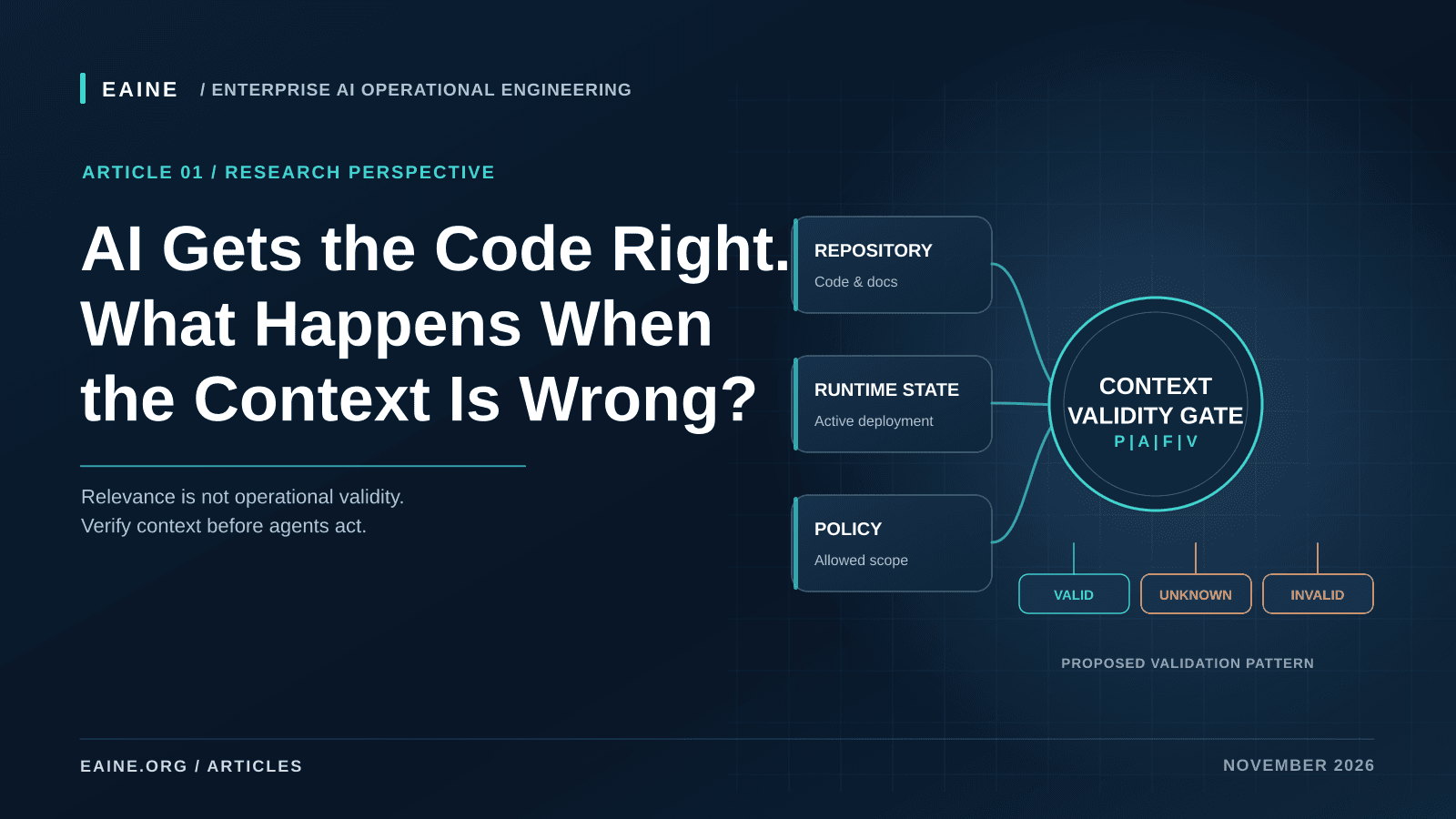
The next serious AI engineering failure may not begin with a bad model. It may begin with good information used in the wrong operational context.
The practical question is simple: Who verifies that the information an agent uses is still valid for this task, deployment and moment?
Retrieval accuracy is not operational correctness
Retrieval-augmented generation and repository-aware coding assistants have greatly improved the discovery of useful technical information. They can find documents, inspect code history, compare implementations and assemble context for reasoning.
But a document can be accurate and still be inappropriate for an intended action. An API can exist while being prohibited in production. A feature can work in one region while being disabled in another. A recently updated guide can describe a rollout that has not yet taken effect.
Traditional retrieval primarily asks: How relevant is this information to the request?
Enterprise operational engineering must ask: Is this information permitted and applicable to the requested action, target deployment and point in time?
Semantic similarity and recency are useful signals. Neither is proof of operational validity.
What the October 28 research establishes
In When Relevant Code Is Wrong: Runtime-Aware Context for AI Coding Agents, Wesley K. G. Assunção and Ramesh Periyathambi introduce operational context validity as a property dependent on task, deployment and time 1.
Their CASE prototype combines repository evidence with runtime configurations and architectural evolution. It classifies retrieved evidence as valid, invalid or unknown, and distinguishes actionable guidance from historical rationale.
The preliminary evaluation covers six development tasks, 15 artifacts and three deployments. It demonstrates feasibility under prototype rules; it does not establish an improvement in production coding-agent correctness.
That limitation matters. The study provides a reason to investigate a design problem, not a production guarantee.
Its central engineering lesson is clear: finding relevant evidence is not the same as establishing that the evidence may legitimately guide an implementation.
Three ways relevant context becomes dangerous
1. Accurate but obsolete
An integration guide describes a payment API retired after a migration. It remains correct as a historical record but should not control a current production change.
2. Accurate but environment-incompatible
A configuration or permission pattern is supported in a development environment but disallowed for production or a regulated tenant. Its relevance does not make it universally applicable.
3. Accurate but conditionally valid
An endpoint is active only behind a feature flag or only for a specific service version. An agent that cannot verify the condition cannot safely assume the endpoint is available.
Freshness alone cannot resolve these cases. An older specification may still be authoritative, while a newer draft may be intended for a future release.
The human cost of a context mistake
A reviewer can inspect syntax, unit tests and the model's explanation and still miss a deployment-specific contradiction. That is not a reason to blame the reviewer. It is a reason to make the missing verification visible in the workflow.
The person approving a change needs to know which sources the agent relied on, what environment they describe and what evidence confirms they are applicable now. The platform team needs a defined response when that evidence is missing. The on-call engineer should not have to discover the mismatch during an incident.
The architectural problem therefore has a human consequence: accountability without enough evidence to make a dependable decision.
The EAINE context-contract connection
 EAINE Publications · Original EAINE editorial illustration. Proposed pattern, not an approved or certified framework control.
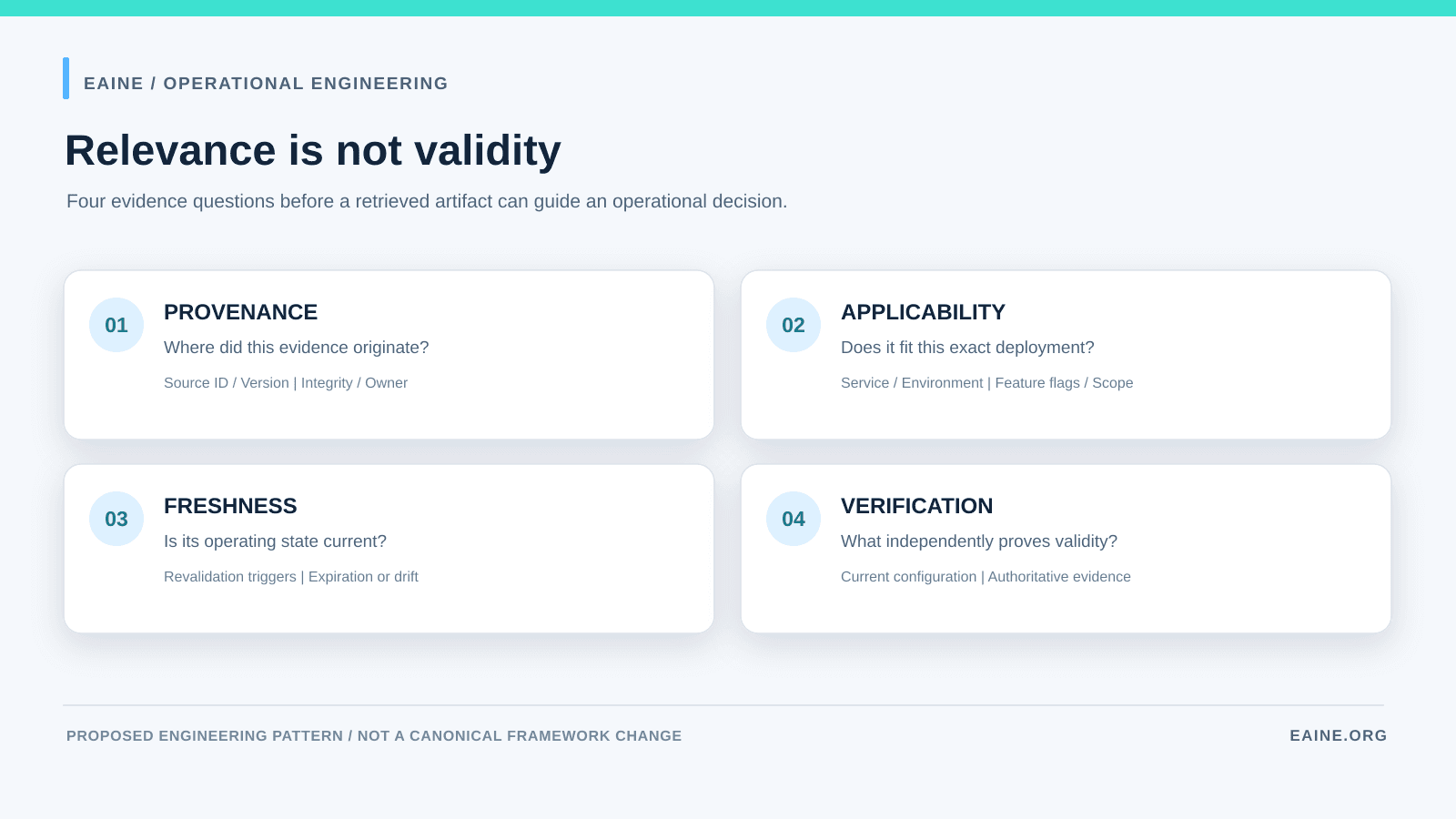
Figure 1. A retrieved document can be relevant without being authorized or valid for the current engineering decision. These checks are proposed evaluation criteria, not certified controls.
EAINE's existing Context Contract describes how identity, intent, evidence, permissions and controls shape what AI may know and do. Operational validity is a narrower implementation question:
Can the system establish that each piece of retrieved evidence applies to this exact engineering decision?
We propose studying an Operational Context Validity Contract as an extension candidate within established context admission and execution boundaries. It is not an approved new EAINE framework component.
The candidate contract would assess four properties:
| Property | Verification question | Example evidence |
|---|---|---|
| Provenance | Where did this information originate, and which version is it? | Repository digest, owner, artifact version |
| Applicability | Does it apply to this task, service, tenant and deployment? | Service manifest, environment mapping, feature flags |
| Freshness | What event or change could make it obsolete? | Deployment change, policy update, expiration |
| Verification | What authoritative evidence confirms its use is legitimate now? | Active configuration, approved service contract |
A model's narrative explanation is not independent verification. Authoritative data should be checked using services and controls outside the model's discretionary reasoning.
Proposed operational context architecture
 EAINE Publications · Original EAINE editorial illustration. Proposed pattern, not an approved or certified framework control.
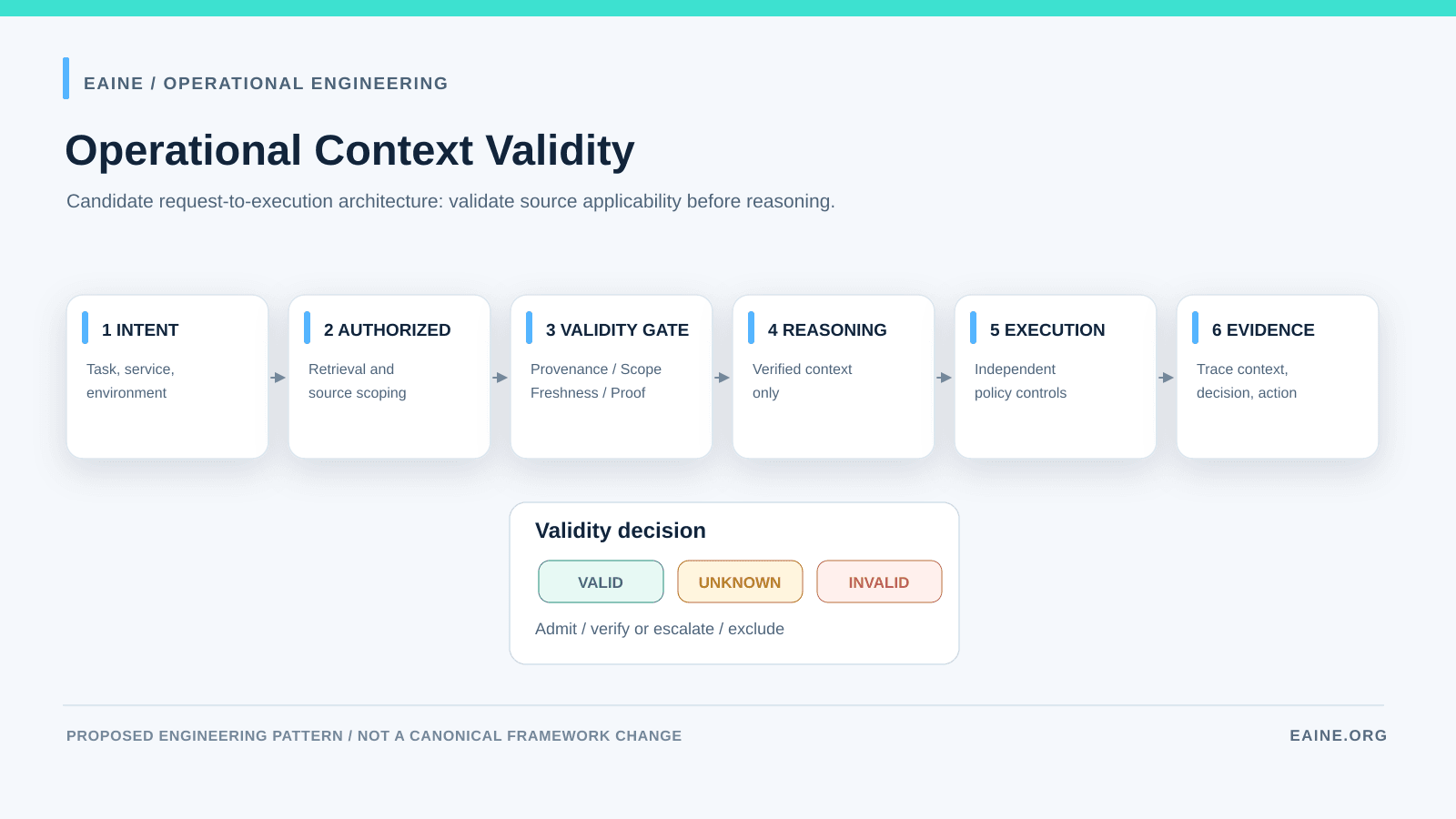
Figure 2. Candidate operational context flow. A validity decision must be enforced outside the model, including an explicit unknown-state escalation path.
The candidate flow is:
Engineering Intent → Identity and Authority → Authorized Retrieval → Operational Validity Check → Verified Context Package → Agent Reasoning → Independent Execution Controls → Evidence Capture
The validity check should classify artifacts into three states.
| State | Interpretation | Expected treatment |
|---|---|---|
| Valid | Applicability established against authoritative evidence | Eligible as actionable context |
| Invalid | Current evidence contradicts its applicability | Exclude from actionable guidance |
| Unknown | Insufficient evidence to decide | Verify, restrict or escalate |
Unknown must never silently become valid. For consequential changes, the inability to establish applicability should lead to a defined stop or escalation path.
A candidate verified context package could retain source identifier, digest, deployment identity, source version, applicable configuration or policy, validation timestamp and invalidation event. These are proposed implementation fields, not an approved EAINE schema.
Example: protecting a service migration
Suppose retrieval returns two payment-handling implementations: a synchronous legacy API and the currently deployed event-driven flow.
Both may rank highly for the engineer's query. The validity layer checks the live deployment manifest, active feature flags, service registry and approved architecture decision.
The historical API is retained only as explanatory evidence. The currently active integration is admitted for implementation guidance only after its conditions are verified.
The model is not necessarily more capable than before. The surrounding engineering system is more disciplined about the evidence allowed to influence its decisions.
Practical acceptance criteria
Before treating this pattern as dependable for consequential engineering workflows, verify that:
- Every actionable artifact has a source and version that can be resolved.
- The intended environment, service and deployment are explicit.
- Relevant architectural migration state and feature flags are checked.
- Invalid context cannot enter the actionable context package silently.
- Unknown context invokes verification or authorized escalation.
- Changes to authoritative runtime state trigger revalidation.
- Generated changes are traceable to admitted evidence.
- Negative tests cover stale, conflicting, cross-environment and missing-context cases.
Two candidate measures should be interpreted together:
Invalid Context Admission Rate = invalid artifacts admitted as actionable ÷ all evaluated artifacts known to be invalid.
Valid Context Retention = applicable artifacts retained as actionable ÷ all evaluated artifacts known to be applicable.
A system that blocks every artifact might appear safe under the first metric but be operationally useless. A credible assessment requires independently labeled ground truth and both measures.
What engineering leadership should decide
An engineering leader should be able to answer three practical questions before allowing AI-generated changes into a consequential system: Which context did the agent use? Who or what verified its applicability? What happens when that validity is unknown?
For a pull-request reviewer, the immediate improvement is not another instruction to “be careful.” It is a review experience that makes evidence, environment and invalidation conditions inspectable. For the platform owner, it is independent context admission and execution control. For a customer, the value is simpler: a service that continues to behave as intended.
A capable model working with invalid context is still an unreliable enterprise system.
The decision worth taking into the next engineering review is whether context validity is being tested or merely assumed.
EAINE research note: The Operational Context Validity Contract is a proposed candidate for exploration. It has not been incorporated into the approved framework, implemented as a universal control or independently validated across enterprise production environments.
References
- When Relevant Code Is Wrong: Runtime-Aware Context for AI Coding AgentsAssunção and Periyathambi, arXivAccessed November 1, 2026
Publication detailsVersion 0.3.1 · Updated November 2, 2026 · Editorially approved
- v0.1.0
Initial editorial draft; source research verified, production publication gate remains open.
- v0.2.0
Refined the human-first opening, reader impact, leadership decision and editorial positioning; preserved technical evidence and candidate boundaries.
- v0.3.0
Integrated original EAINE hero and two topic-specific editorial diagrams with accessible text, rights metadata and section-aligned explanations.
- v0.3.1
Refined the public headline and SEO title for clear EAINE problem-to-decision positioning; preserved the article body and canonical URL.