
In this article 21 sections
A customer tells an AI assistant not to reuse a personal detail. The assistant acknowledges the request. At the next interaction, the same detail appears again.
This is a hypothetical example, but it reveals a real design challenge. Was the detail kept in a conversation summary? Was it copied into an index? Did an earlier tool result turn into a persistent memory? And who can verify that the customer's instruction was actually respected?
Memory helps an assistant provide continuity. It also creates a new responsibility to the people whose information it retains.
An engineer wants the agent to remember a useful lesson from a production incident. A customer expects a revoked preference to stop influencing future responses. A security owner needs to know that one tenant's information cannot cross into another tenant's workflow.
The question is not how much an enterprise AI agent can remember. It is what that agent has a continuing right to remember, trust and use.
Memory is becoming operational state
AI agents increasingly retain earlier task results, interaction histories, preferences, summaries and learned operational patterns. This can improve continuity and reduce repeated work.
An engineering agent might remember a previously verified deployment procedure. A support assistant could retain an explicitly authorized preference. An operations agent might draw on a completed incident investigation.
But persistent memory changes the trust model.
Information collected under one identity, policy, deployment or time period may later influence another action. Summaries can lose qualifications or source attribution. Revoked permissions may outlive the session in which they were granted.
Stored information can also be malicious. An instruction injected through an untrusted repository or document may become persistent agent state and influence later behavior.
Memory is therefore not merely a convenience feature. It is a security-relevant operational dependency.
What recent research contributes
The October 28, 2026 paper Routed Continual Learning studies how agent experience can be partitioned into clusters and reused through different memory mechanisms 1.
Instead of presenting an agent with one global history, its architecture routes a task to retained state selected for that class of problem. In its evaluation, the authors report better normalized reward and lower estimated API costs than a global in-context learning baseline under their experimental conditions.
These results establish neither universal performance improvements nor a proven secure enterprise memory-governance design. They do show that which experience is retained, how it is represented and when it is routed back into a task are important architecture decisions.
OWASP has also documented persistent memory and context poisoning risks in agentic systems 2. An agent that carries untrusted content into future interactions may perpetuate an instruction injection beyond its original source.
The enterprise challenge joins both perspectives: useful memory must remain bounded by authority, provenance and continued operational validity.
Why remembering is a promise to the user
For a customer, memory feels like continuity when the assistant remembers something useful. It feels like a breach of trust when an outdated, private or corrected detail unexpectedly returns.
For the people operating the service, “the agent remembered it” is not a satisfactory explanation. They need to establish the source, the permission that allowed retention, the conditions under which the memory may be reused and what happens when those conditions change.
A good memory design should let people benefit from continuity without requiring them to surrender control of their information.
Four types of retained information
Not every memory should have the same handling rules.
Episodic memory
Records of prior tasks, conversations and workflow results. They provide history but should not automatically become present-day instructions.
Semantic memory
Consolidated facts, business knowledge and reusable domain information. These need versioned, authoritative sources and applicability checks.
Procedural memory
Previously successful tool use, instructions and operational steps. Procedures require revalidation against current system capabilities, permissions and policy.
Preference memory
Authorized user preferences and interaction settings. These require purpose limitation, user controls, appropriate sharing scope and retention.
An additional distinction is important: operational memory is not the same as authoritative audit evidence. Memory may be revised, superseded or deleted. Audit records may be subject to independent retention, preservation and access obligations. Combining them into one ungoverned store creates avoidable risk.
The limitation of global memory
A single shared memory store may improve apparent retrieval convenience but create unsafe context mixing.
A private fact from Tenant A must not become context for Tenant B. A clinical record from one patient must not be reused as another person's data. A customer negotiation cannot automatically be generalized into a cross-company instruction. A retired runbook cannot become current production policy through repetition.
Semantic similarity is not an authorization decision.
Even when storage is centralized, access must be enforced by independently validated identity, tenant, purpose and policy conditions.
Prompt instructions such as do not reveal private tenant information are not sufficient isolation controls.
Proposed EAINE Agent Memory Lifecycle Contract
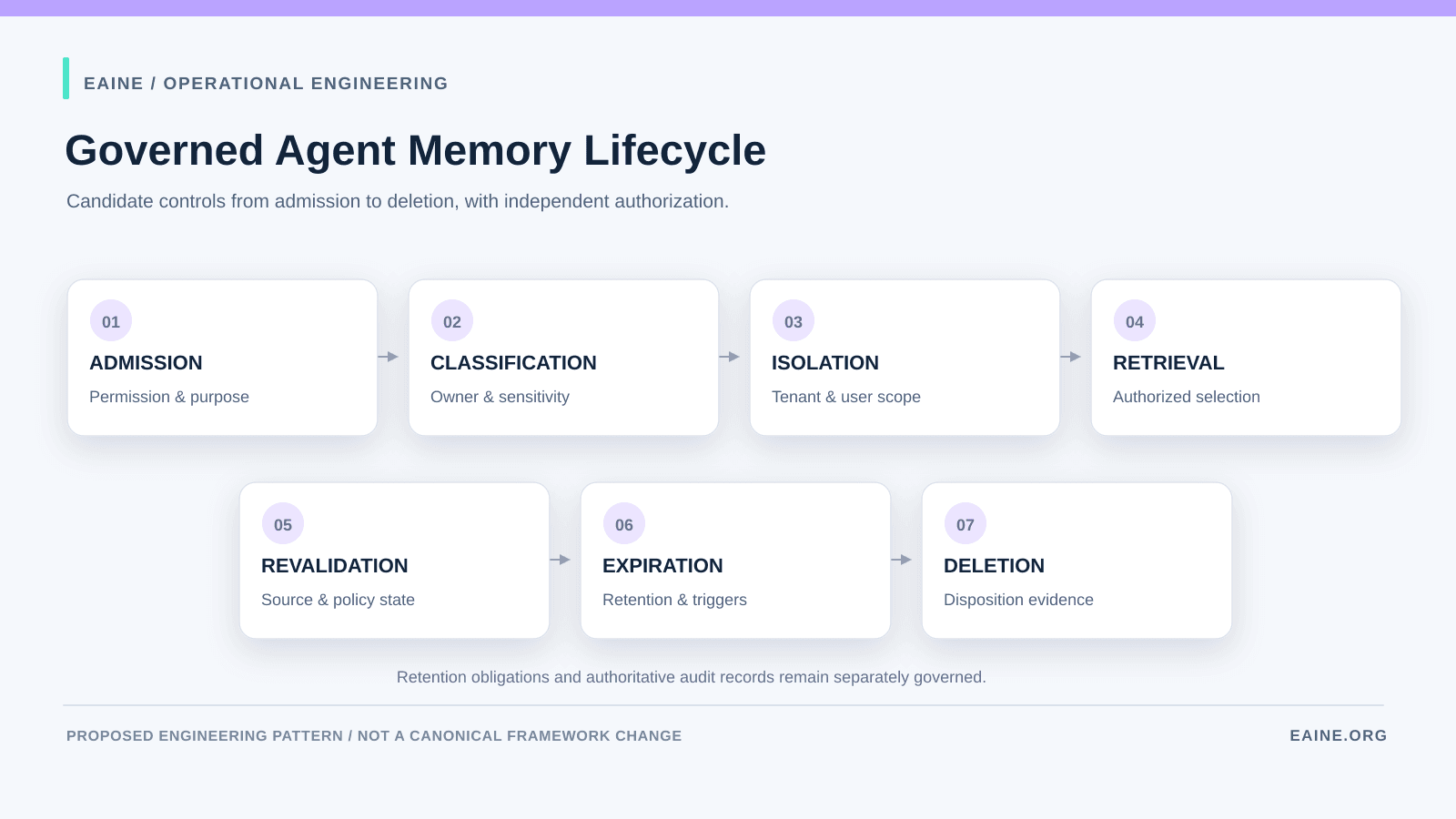 EAINE Publications · Original EAINE editorial illustration. Proposed pattern, not an approved or certified framework control.
Figure 1. Memory is admitted for a stated purpose and remains subject to ongoing authorization, correction, expiration and verifiable retention rules.
EAINE proposes investigating an Agent Memory Lifecycle Contract as an editorial research candidate within existing governed-context boundaries. This is not a canonical EAINE control or a modification to the approved framework.
The candidate lifecycle has seven activities:
- Admission. Decide whether information is authorized, useful and sufficiently trustworthy to retain.
- Classification. Record memory type, owner, source, sensitivity and permitted purpose.
- Isolation. Enforce identity, tenant, workload and data-sharing boundaries before retrieval.
- Retrieval. Select relevant memory subject to independent policy checks.
- Revalidation. Check whether stored information remains applicable to current policies and business state.
- Expiration and deletion. Enforce retention, revocation and disposition requirements.
- Evidence and review. Record material memory changes and control decisions without unnecessarily copying sensitive content into logs.
The lifecycle should cover derived summaries, retrieval indexes and caches as well as primary storage.
Candidate memory reference architecture
A conceptual request path is:
Authorized Intent → Identity and Purpose Validation → Memory Routing → Policy-Scoped Stores → Provenance and Validity Evaluation → Context Contract Admission → Agent Reasoning → Independent Execution Controls
An accompanying lifecycle path is:
Memory Creation → Classification → Versioning → Revalidation → Supersession / Expiration → Deletion / Preservation → Evidence
The router can help select useful context, but should not become the final security authority. Authorization must be enforced before sensitive memory becomes model context.
Five controls that matter most
1. Source provenance that survives summarization
AI-generated summaries should retain sufficient lineage to verify important facts. Rewriting an observation does not make the observation more authoritative than its source.
2. User and tenant isolation
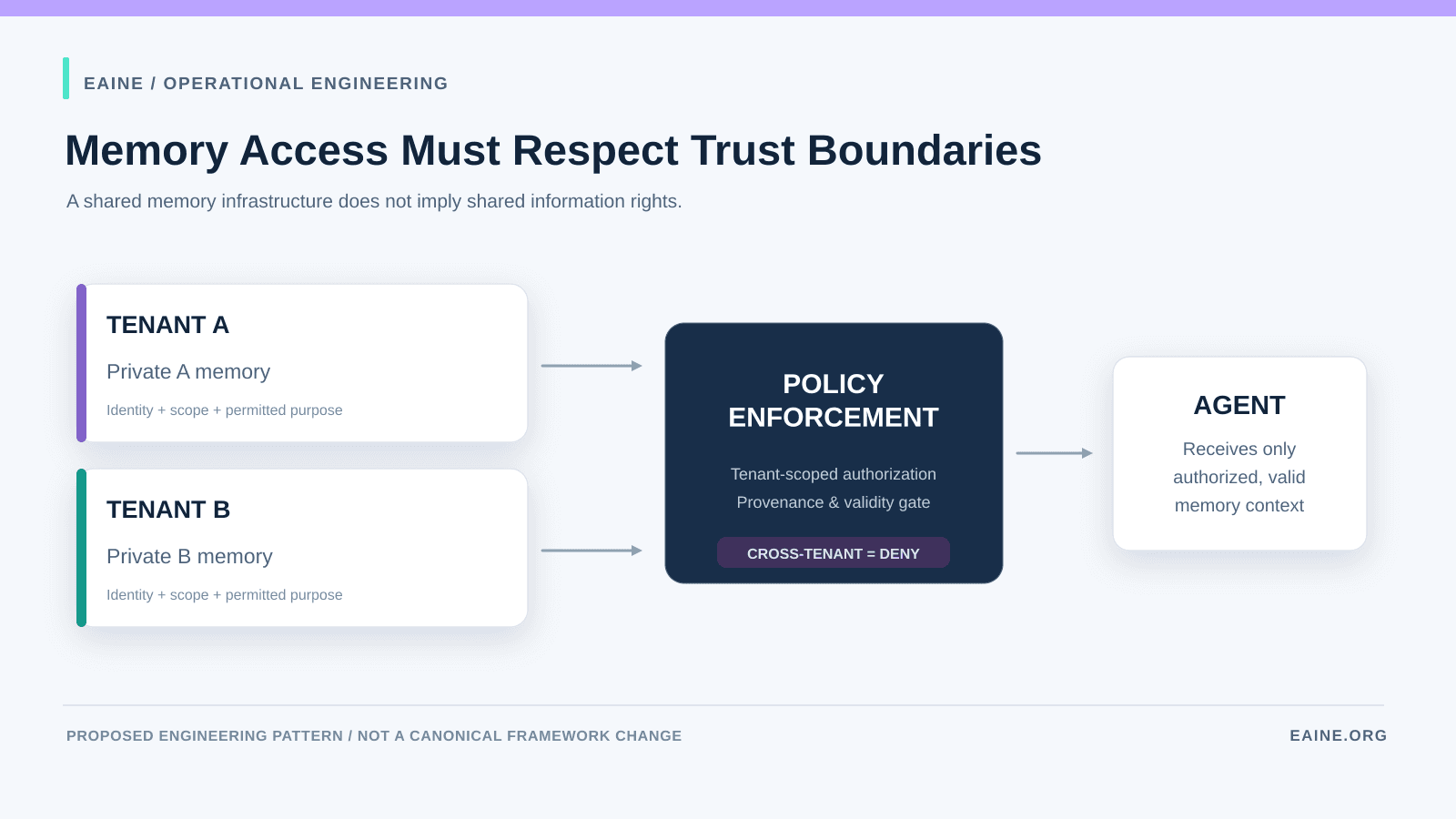 EAINE Publications · Original EAINE editorial illustration. Proposed pattern, not an approved or certified framework control.
Figure 2. A shared memory platform must not turn tenancy into implied permission. The agent sees only context independently authorized for the present identity and action.
Enforce tenant and user authorization at the storage and retrieval boundary. Review caches, derived embeddings, summarization and cross-session reuse for indirect leakage paths.
3. Stale-memory detection
Expiry is not sufficient. A recent document may describe an upcoming deployment. A much older record may remain authoritative. Check applicability against source changes, current business state and versioned policies.
4. Resistance to persistent poisoning
Treat external instructions, tool outputs and user-supplied documents as untrusted unless independently admitted. Prevent lower-trust content from being promoted into durable policy or procedural authority.
5. Verifiable deletion and retention
Define how removal propagates to indexes, caches, summaries and backups. Some retained audit records or backups may require restricted access and time-bounded disposition rather than immediate erasure. Deletion claims should state what has been removed, what remains and why.
A practical isolation and invalidation test
Consider an agent serving two independent customer organizations.
First, it processes private information for Tenant A. Later, a user from Tenant B submits a semantically similar request.
A credible test should establish that:
- Tenant A's private information is not returned to Tenant B.
- Shared caches cannot bypass the tenant boundary.
- A revoked authorization prevents subsequent unauthorized reuse.
- A stale preference or expired exception is excluded from consequential decisions.
- Injected instructions from a historical document do not become privileged policy.
- Authorized deletion follows documented timing and retention requirements.
- Evidence of enforcement remains available without disclosing the private memory content.
Test direct retrieval and indirect paths through summaries, embeddings and tool-call explanations.
Measure memory as an engineering control
Useful candidate measures include:
| Measure | Question |
|---|---|
| Unauthorized memory access rate | Do scoped access boundaries hold? |
| Stale-memory admission rate | Does invalid memory reach consequential reasoning? |
| Provenance completeness | Can important memory be traced to verifiable sources? |
| Revalidation coverage | Is memory rechecked when conditions change? |
| Deletion completion against policy | Are disposition obligations satisfied? |
| Verified outcome improvement | Does governed memory produce measurable value? |
These measurements require negative testing and independently labeled cases. A low observed error rate does not prove a design is secure.
Connection to the existing EAINE architecture
The existing Context Contract addresses evidence admission and permitted AI actions. Governed memory adds lifecycle concerns across multiple interactions and time periods.
It should preserve continuity without allowing history to silently become authority.
The proposed memory lifecycle is a research and implementation candidate to be evaluated separately. It does not introduce a new approved EAINE plane, control family, SDLC stage or maturity level.
What should an enterprise agent forget?
It should stop using information when its purpose ends, its authorization is withdrawn or its applicability can no longer be established. Where the applicable retention rules require preservation, that distinction should be explicit rather than hidden behind a claim that everything was deleted.
For the customer, the meaningful promise is control. For the engineering team, it is traceability and safe revalidation. For the organization, it is a defensible separation between useful memory and retained audit evidence.
Dependable agent memory is not the memory that retains the most. It is memory whose use remains controlled, current and accountable.
The question for the next architecture review is whether users and operators can actually verify what the agent retains, reuses and stops using.
EAINE research note: The Agent Memory Lifecycle Contract is proposed for study. Privacy, data retention, tenant isolation and security mechanisms require implementation-specific review and validation before formal adoption.
References
- Routed Continual LearningPhilip et al., arXivAccessed November 1, 2026
- Memory Is a Feature. It Is Also an Attack SurfaceOWASP Gen AI Security ProjectAccessed November 1, 2026
Publication detailsVersion 0.3.1 · Updated November 2, 2026 · Editorially approved
- v0.1.0
Initial governed agent memory article with research caveats, candidate lifecycle and isolation checks.
- v0.2.0
Refined the human-first opening, reader impact, leadership decision and editorial positioning; preserved technical evidence and candidate boundaries.
- v0.3.0
Integrated original EAINE hero and two topic-specific editorial diagrams with accessible text, rights metadata and section-aligned explanations.
- v0.3.1
Refined the public headline and SEO title for clear EAINE problem-to-decision positioning; preserved the article body and canonical URL.