
In this article 18 sections
At an all-hands engineering review for a Fortune 500 enterprise, the Vice President of Software Engineering stood before a slide that should have signaled total triumph.
Six months after deploying AI coding assistants and autonomous code-generation agents across 1,200 developers, the activity metrics were off the charts:
- 44% of all committed code was now generated or suggested by AI.
- Average time from ticket creation to first commit had plummeted by 38%.
- Developers had merged a record-breaking 2,400 pull requests in a single sprint.
The executive dashboard glowed bright green.
Then the VP opened the second slide, and the room fell silent.
Over the same six-month period:
- Lead time from PR creation to production deployment had stretched by 19 days.
- Senior and staff engineers were spending an average of 5.4 hours per day reviewing pull requests, experiencing severe cognitive burnout.
- Escaped defect rates in staging had surged by 42%, driven by subtle concurrency race conditions and deprecated database calls that static linters failed to catch.
- Production rollbacks had doubled.
The VP summarized the crisis in a single sentence:
"We have optimized our organization to write code four times faster than our architecture can comprehend, review, verify, and operate."
The Implementation Abundance Paradox
This is the great unspoken paradox of the AI-native development era.
For seventy years, the fundamental bottleneck in software engineering was implementation. Writing clean code, implementing algorithms, and typing out boilerplate was labor-intensive and expensive. Engineering management understandably treated "code velocity"—lines written, tickets closed, PRs submitted—as a proxy for productivity.
Generative AI and autonomous coding agents have inverted that reality overnight.
Implementation is no longer scarce. Implementation is abundant, cheap, and virtually instantaneous. With a single prompt, a junior developer or autonomous agent can generate 1,200 lines of syntactically flawless Python, complete with docstrings and mock unit tests.
THE TRADITIONAL SDLC (Implementation Bottleneck)
[Requirements] ──► [Architecture] ──► [IMPLEMENTATION (Slow, Scarce)] ──► [Review] ──► [Deploy]

THE UNGOVERNED AI-NATIVE SDLC (The Reviewer Tsunami)
[Prompt] ──► [AI GENERATION (Instant, Abundant)] ──► [REVIEW & VERIFICATION (Choked, Overwhelmed)]
                    │                                             ▲
                    ▼                                             │
          1,000s of Synthetic PRs ────────────────────────────────┘
          * Reviewers rubber-stamp out of exhaustion.
          * Invisible architectural debt floods into production.
When implementation becomes instantaneous, the engineering bottleneck shifts entirely downstream.
The true bottlenecks of modern software engineering are now:
- Architectural Coherence: Does this code respect enterprise invariants, security boundaries, and domain models?
- Reviewability: Can a human reviewer verify that the code handles failure modes without spending hours deciphering synthetic logic?
- Verification & Assurance: Does the system possess automated evidence that the software behaves correctly under adversarial conditions?
- Operational Survivability: Can on-call engineers debug, maintain, and roll back this code when production breaks at 3:00 AM?
If an engineering organization measures AI adoption solely by code volume, it is optimizing the one part of the lifecycle that no longer needs acceleration—while overwhelming the review and verification systems that keep the business alive.
What the Research Proves: The DORA 2025 Insight
This dynamic is not merely anecdotal; it is empirically documented at global scale.
The 2025 DORA State of AI-Assisted Software Development Report, conducted by Google Cloud's DevOps Research and Assessment team across nearly 5,000 engineering respondents and over 100 hours of qualitative fieldwork, delivered a sobering conclusion Source: DORA Report 2025:
AI acts as an amplifier of underlying organizational maturity.
In organizations with brittle delivery systems, weak test automation, and loose governance, AI tooling acted as an accelerant for technical debt. Developers generated mountains of unvetted code, choking review queues and increasing delivery friction.
Conversely, high-performing organizations with strong architectural contracts, automated verification gates, and continuous delivery pipelines leveraged AI to achieve dramatic throughput gains without sacrificing stability Source: Google Research.
The message for engineering leaders is clear: Tooling adoption alone does not create engineering performance. Only an evidence-driven delivery system can transform AI speed into enterprise value.
The Synthetic PR Tsunami & Reviewer Fatigue Trap
A developer can prompt an agent to generate an entire microservice in 45 seconds. But reading that code, understanding its edge cases, verifying its thread safety, and validating its database indexes takes a senior engineer 60 minutes of intense focus.
When hundreds of synthetic PRs hit the queue every week, senior engineers face a terrible choice: become a permanent blocker, or start "LGTM" rubber-stamping code they barely understand. The moment rubber-stamping begins, your enterprise software architecture begins an irreversible decline.
The Productivity Mirage vs. Verified Value
To prevent AI from degrading system reliability, organizations must replace vanity activity metrics with Verified Outcome Metrics.
| Measurement Dimension | The Productivity Mirage (Vanity Metrics) | The Governed AI SDLC (Verified Outcomes) |
|---|---|---|
| Primary Metric | Lines of AI code generated / PR volume | Lead Time to Verified Business Value |
| Developer Activity | Copilot acceptance rate (%) | Rework Ratio (code deleted or refactored within 30 days) |
| Quality Assessment | "Unit tests passed in CI" | Defect escape rate & architectural consistency score |
| Review Health | Number of PRs reviewed | Review queue wait time & reviewer cognitive load |
| Security Posture | Static code scanning (SAST) | Adversarial red-teaming & independent policy enforcement |
| Architecture | Undocumented agent-generated abstractions | Explicit Context Contracts & immutable ADR linkage |
| Audit Readiness | Git commit log and issue comments | Cryptographic Five Operating Traces (Intent, Authority, Evidence) |
The Governed AI-Native SDLC: Nine Stages of Verifiable Evidence
The Enterprise AI-Native Engineering (EAINE) Framework structures software delivery around a Nine-Stage AI-Native SDLC.
Rather than treating AI as an ad-hoc assistant sprinkled across IDEs, the governed SDLC establishes an end-to-end chain of verifiable evidence from initial requirement to post-release operations.
┌────────────────────────────────────────────────────────────────────────────────────────┐
│                        THE EAINE NINE-STAGE GOVERNED AI SDLC                           │
├────────────────────────────────────────────────────────────────────────────────────────┤
│ 1. Intent & Problem Framing                                                            │
│    Requirement declared with machine-readable acceptance criteria and business owner. │
├────────────────────────────────────────────────────────────────────────────────────────┤
│ 2. Context & Architecture Contract                                                     │
│    Data boundaries, service interfaces, tenant isolation, and security ceilings set.   │
├────────────────────────────────────────────────────────────────────────────────────────┤
│ 3. Governed Implementation (Human + AI)                                                │
│    Code, configuration, and prompts authored within explicit architectural invariants. │
├────────────────────────────────────────────────────────────────────────────────────────┤
│ 4. Automated Verification & Adversarial Testing                                        │
│    Fault injection, indirect prompt injection testing, and schema mutation suites.     │
├────────────────────────────────────────────────────────────────────────────────────────┤
│ 5. Independent Evaluation & Policy Gating                                              │
│    External Policy Enforcement Points verify permissions independently of model code. │
├────────────────────────────────────────────────────────────────────────────────────────┤
│ 6. Attenuated Release & Progressive Deployment                                         │
│    Canary deployments with short-lived tokens, scoped budgets, and rollback triggers.  │
├────────────────────────────────────────────────────────────────────────────────────────┤
│ 7. Runtime Observability & Trajectory Monitoring                                       │
│    Real-time telemetry of tool DAGs, token costs, latency spikes, and retry loops.     │
├────────────────────────────────────────────────────────────────────────────────────────┤
│ 8. Incident Reconstruction & Forensic Audit                                            │
│    Tamper-evident logs allow complete deterministic replay of agent decisions.         │
├────────────────────────────────────────────────────────────────────────────────────────┤
│ 9. Governed Learning & Continuous Remediation                                          │
│    Production failures automatically convert into permanent regression test cases.     │
└────────────────────────────────────────────────────────────────────────────────────────┘
Notice that this lifecycle does not slow down delivery; it automates the verification that makes high-speed delivery safe. Every stage emits a verifiable artifact that joins an unbroken Chain of Evidence.
Grounding Delivery in the Five Operating Traces
How do engineering leaders know whether a release is truly production-ready?
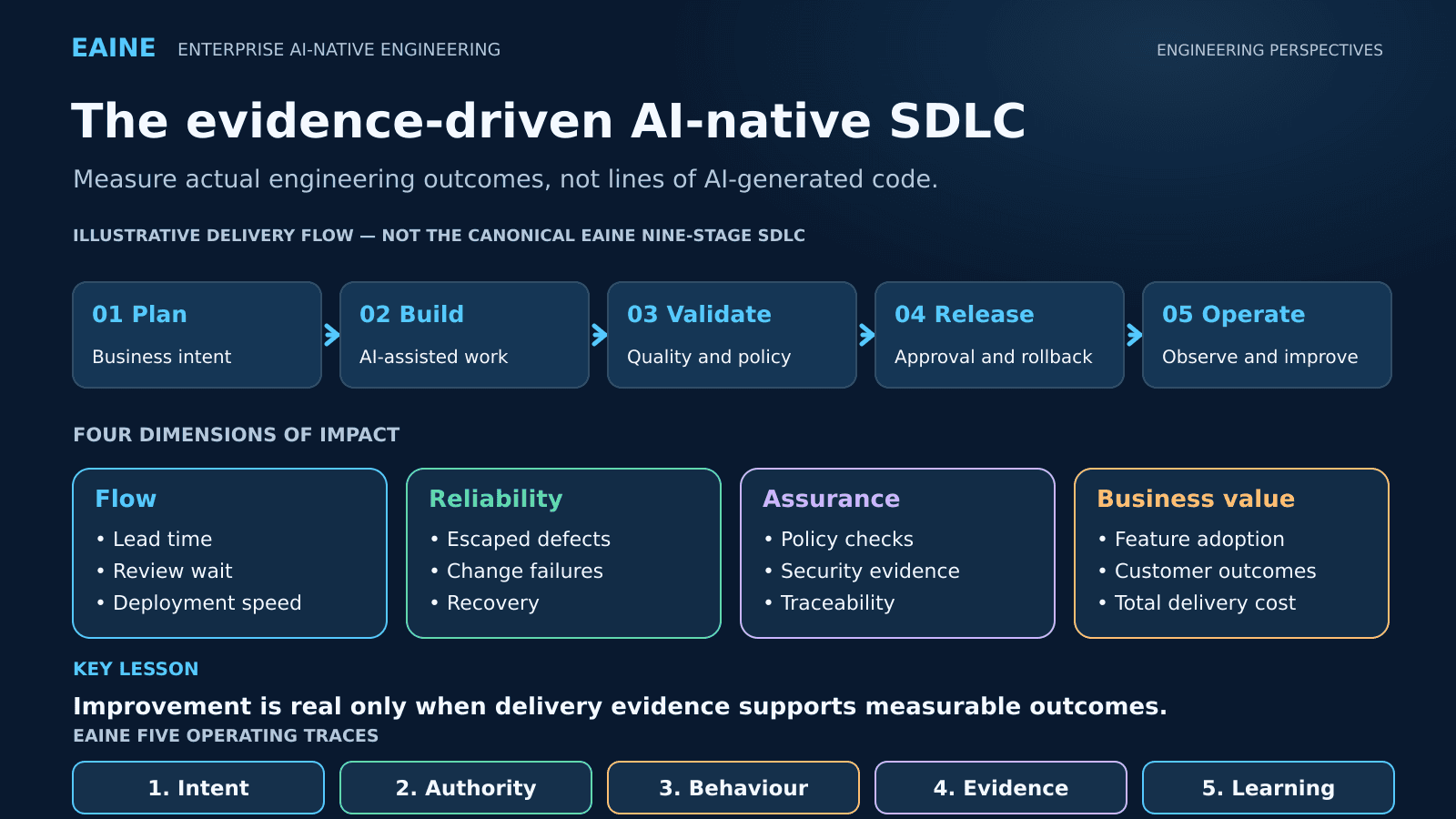
By linking each stage of the AI SDLC to EAINE's Five Operating Traces:
1. Intent Trace (Why did we make this change?)
Every pull request, agent workflow, and configuration change must link directly to an approved business requirement. If an agent refactors an internal module or adds a new API dependency, the Intent Trace asserts whether that change was authorized by the business mandate or hallucinated during implementation.
2. Authority Trace (Who authorized the change and permissions?)
Records who approved the architecture, who reviewed the pull request, and which machine credentials the software uses at runtime. It enforces that AI-generated code never bypasses human approval gates for critical infrastructure.
3. Behaviour Trace (What actually changed and executed?)
Captures the exact diff of code, dependencies, prompts, and tool configurations. In runtime agentic systems, it records the complete trajectory of actions taken during execution.
4. Evidence Trace (What proves the system works?)
The cryptographic record of test executions, static analyses, adversarial red-team evaluations, and performance benchmarks. A pipeline cannot deploy code based on developer assertions; it deploys code based on immutable evidence.
5. Learning Trace (How does the system improve?)
Captures post-incident reviews, defect remediations, and performance adjustments. When a defect is discovered in production, the Learning Trace ensures that an automated test is added to the release gate so the same failure can never recur.
This approach reflects the lifecycle assurance principles outlined in the NIST AI Risk Management Framework Core (AI RMF 1.0) Source: NIST AI RMF and the structured evaluation frameworks discussed at the Microsoft Research and Carnegie Mellon University AI Agent Governance Workshop Source: Microsoft Research.
Four Balanced Dimensions for Engineering Dashboards
To build an engineering leadership dashboard that cannot be gamed by code volume, track four balanced dimensions:
┌────────────────────────────────────────────────────────────────────────────────────────┐
│                   THE BALANCED AI-NATIVE ENGINEERING DASHBOARD                         │
├────────────────────────────────────────────────────────────────────────────────────────┤
│ 1. Delivery Flow                                                                       │
│    • Lead Time for Changes (commit to production).                                     │
│    • PR Queue Dwell Time (hours spent waiting for human review).                       │
│    • Deployment Frequency to production.                                               │
│                                                                                        │
│ 2. System Reliability & Quality                                                        │
│    • Change Failure Rate (% of releases requiring hotfixes or rollbacks).             │
│    • 30-Day Code Churn / Rework Ratio (% of AI code rewritten within one month).       │
│    • Mean Time to Restore Service (MTTR) during production incidents.                  │
│                                                                                        │
│ 3. Architectural Assurance                                                             │
│    • Percentage of changes with verified Architecture Decision Records (ADRs).         │
│    • Automated security red-teaming coverage across agentic workflows.                 │
│    • Trace Completeness Score across the Five Operating Traces (target: 100%).         │
│                                                                                        │
│ 4. Verified Business Value                                                             │
│    • Feature adoption and user engagement metrics.                                     │
│    • Net infrastructure & inference cost per delivered feature.                       │
│    • Developer satisfaction and cognitive load scores (combating burnout).             │
└────────────────────────────────────────────────────────────────────────────────────────┘
A 90-Day Enterprise Transition Plan
Transitioning your engineering organization from ungoverned AI generation to an evidence-driven AI SDLC requires a disciplined 90-day roadmap:
Days 1–30: Establish Baselines and Stop the Bleeding
- Stop reporting raw lines of code and PR volume as productivity indicators.
- Measure your true baseline: lead time for changes, PR review wait times, code churn, and change failure rates.
- Establish team review limits: restrict pull requests to <= 300 lines of changes to combat synthetic reviewer fatigue.
Days 31–60: Implement Context Contracts and Automated Verification
- Require explicit Architecture Decision Records (ADRs) and Context Contracts for any AI-assisted subsystem.
- Introduce automated adversarial testing (OWASP GenAI Red Teaming methodology) into CI/CD pipelines.
- Deploy Policy Enforcement Points (PEPs) to decouple runtime authorization from model prompts.
Days 61–90: Codify the Evidence Chain
- Automate the generation of the Five Operating Traces in your CI/CD and deployment pipelines.
- Mandate that production release gates require complete cryptographic Evidence Traces.
- Connect post-incident retrospectives directly into the automated regression test repository.
The Leadership Takeaway
In the pre-AI era, engineering leadership was about maximizing the speed of code production.
In the AI-native era, engineering leadership is about maximizing the velocity of verified trust.
Anyone can generate code. High school students, prototype bots, and prompt enthusiasts generate thousands of lines of code every day. But enterprises do not run on code; enterprises run on operational trust, system stability, regulatory compliance, and customer reliability.
When you shift your organization from measuring code volume to measuring verifiable evidence, you transform AI from a generator of technical debt into the most powerful engine of enterprise innovation your organization has ever possessed.
Scope and Limitations
This article provides an engineering and management framework for establishing evidence-driven software delivery in AI-assisted and AI-native environments. It presents implementation principles based on the EAINE Framework and does not claim an external industry certification or formal compliance attestation. Organizations operating in regulated environments must align these practices with applicable industry-specific legal, security, and auditing mandates.
It is, “What measurable improvement did AI contribute to the engineering system, and what evidence supports that conclusion?”
The maturity of AI-native engineering is demonstrated by controlled outcomes, not by the volume of AI activity.
Scope and limitations
This article proposes an engineering measurement and adoption approach. It does not claim causal effects for EAINE, establish an industry benchmark, or guarantee time or cost savings. The DORA research reports population-level patterns that require local validation before they guide specific investment decisions.
References
- DORA — State of AI-assisted Software Development 2025DevOps Research and Assessment (DORA)Accessed October 27, 2026
- Google Research — DORA 2025 report bibliographic record and abstractGoogle ResearchAccessed October 27, 2026
- OWASP — GenAI Red Teaming Manual Version 1.0OWASP GenAI Security ProjectAccessed October 27, 2026
- Microsoft Research and Carnegie Mellon — AI agent evaluation workshopMicrosoft Research & CMU AIMSECAccessed October 27, 2026
- NIST — AI Risk Management Framework CoreNational Institute of Standards and TechnologyAccessed October 27, 2026
Publication detailsVersion 1.0.0 · Updated October 27, 2026 · Editorially approved
- v1.0.0
Published following editorial, factual, accessibility, and publication review.