

In this article 31 sections
In brief
Enterprise adoption of generative and agentic AI is frequently organized around the capabilities of the model: benchmark performance, context-window size, reasoning quality, latency, and cost. These properties matter, but they do not by themselves determine whether an enterprise system understands a user's situation, retrieves authoritative knowledge, respects policy, coordinates permitted actions, or produces an accountable outcome.
This article examines the transition from model-centric AI to context-aware intelligence. Drawing on retrieval, long-context, memory, graph-based retrieval, agent reasoning, provenance, and AI-risk literature, it identifies the responsibilities that sit outside the model. It then introduces a five-stage enterprise framework: Intent → Context → Reasoning → Action → Outcome, with governance and evaluation operating across every stage and controlled learning connecting outcomes back to future context assembly.
The central argument is that context should be treated as a governed runtime product rather than as an undifferentiated prompt payload. The framework separates model capability from system capability, defines a context contract for enterprise tasks, and introduces an evaluation model that measures context quality alongside model and outcome quality.
Keywords: context-aware intelligence, context engineering, enterprise AI, AI-native systems, retrieval-augmented generation, enterprise memory, AI governance, evaluation, provenance
1. Introduction
The current generation of enterprise AI systems often begins with a model and expands outward.
Teams select a foundation model, add instructions, connect documents through retrieval, expose tools, and introduce memory. This model-first path is understandable. It creates a visible capability quickly and provides a practical way to learn.
It also encourages a misleading unit of analysis.
When a system gives an incorrect, incomplete, unauthorized, or operationally unsuitable response, the failure is often attributed to the model. Yet the model may never have received the identity, business state, policy, history, evidence, or authority needed to reason appropriately. In other cases, the system supplies a large volume of information without determining what is current, trusted, permitted, or material to the decision.
The difference is important. A model generates or selects an output from the information and capabilities available to it. An enterprise system is responsible for deciding what information and capabilities should be available in the first place.
This article addresses a practical enterprise question:
How can enterprises move from model-centric AI implementations toward context-aware AI-native systems that connect intelligence with trusted knowledge, policy, workflow state, permitted action, evaluation, and accountable human outcomes?
The proposed answer is not a single product or retrieval technique. It is an architectural separation of concerns in which context becomes a governed runtime capability and the model becomes one component within a larger decision system.
2. Evidence behind the framework
The framework combines three sources of evidence and architecture reasoning:
The method combines three forms of analysis:
- Published research. The analysis examines primary research on retrieval-augmented generation, long-context behavior, adaptive retrieval, memory management, graph-based retrieval, and reasoning-plus-action patterns.
- Standards alignment. It uses NIST's lifecycle-oriented AI risk guidance and W3C provenance concepts to define governance and traceability responsibilities.
- Practitioner architecture synthesis. It converts the observed responsibilities into a system framework intended for enterprise design, evaluation, and future empirical testing.
The scope is intentionally bounded. The framework does not guarantee correctness or prescribe a universal technology stack. It offers a testable enterprise pattern and identifies the evidence organizations should use to evaluate it.
3. The limits of model-centric AI
Model-centric AI treats the model as the primary source of intelligence and the surrounding system as a delivery mechanism. In this view, improvements usually focus on model selection, prompt design, fine-tuning, context-window expansion, and inference optimization.
These interventions can improve performance. They do not resolve four system-level limitations.
3.1 Parametric knowledge is not enterprise state
The knowledge encoded in a model's parameters is not a reliable representation of an organization's current policies, permissions, customers, operations, or decisions. The foundational RAG work demonstrated the value of combining parametric memory with explicit external memory for knowledge-intensive tasks 1. For enterprise systems, this establishes an important principle: relevant knowledge may need to be retrieved at runtime rather than assumed to reside in the model.
Retrieval alone, however, does not establish authority. A semantically relevant document may be obsolete, superseded, restricted, or inapplicable to the current legal entity and workflow.
3.2 More tokens do not guarantee better use of evidence
Longer context windows make larger information sets available to a model. Availability is not equivalent to dependable use. Research has shown that performance can vary with the position of relevant information and may degrade when important evidence appears within the middle of a long input 2.
The enterprise implication is not to avoid long context. It is to engineer selection, ordering, compression, and evaluation instead of treating token capacity as a context strategy.
3.3 Memory without lifecycle controls can preserve the wrong thing
Long-running enterprise interactions need memory across turns, tasks, and sessions. Work such as MemGPT illustrates how systems can coordinate multiple memory tiers to operate beyond a fixed context window 4.
Enterprise memory adds further questions. Who is allowed to remember the information? For which purpose? For how long? What happens when the source changes, consent is withdrawn, or a previous decision is reversed? A memory mechanism becomes an enterprise capability only when retention, correction, provenance, and access are governed.
3.4 Reasoning and action create operational responsibility
Agent patterns connect model reasoning with external actions. ReAct demonstrated the value of interleaving reasoning and task-specific action to gather information and update plans 6. In an enterprise, the same pattern raises authorization and accountability requirements. A system may be able to invoke a tool while lacking authority to commit the resulting business action.
The critical boundary is therefore not simply between model and tool. It is between recommendation and accountable execution.
4. Defining context-aware intelligence
In this article, context-aware intelligence means:
A system-level capability that assembles a sufficient, trusted, current, authorized, and traceable representation of a situation so that models, rules, tools, agents, and humans can produce an appropriate outcome within defined boundaries.
This definition has five implications.
- Context is purpose-bound. The right context depends on the task and decision boundary.
- Context is selective. Sending all available information is neither necessary nor safe.
- Context is governed. Identity, policy, consent, and authority shape what may be assembled.
- Context is traceable. Material evidence should remain connected to its source and transformation.
- Context is evaluated through outcomes. Relevance scores alone cannot establish business fitness.
Context-aware intelligence is therefore broader than retrieval-augmented generation. Self-RAG, for example, explores adaptive decisions about whether retrieval is needed and reflects on retrieved passages and generated content 3. GraphRAG addresses classes of global questions that may not be served well by local similarity retrieval alone 5. These advances demonstrate that retrieval strategies can become more adaptive and structured. The enterprise framework must additionally account for policy, workflow state, source authority, permissions, actions, and human responsibility.
5. Proposed context-aware intelligence framework
The framework organizes the system around five observable stages rather than around a particular model or vendor.
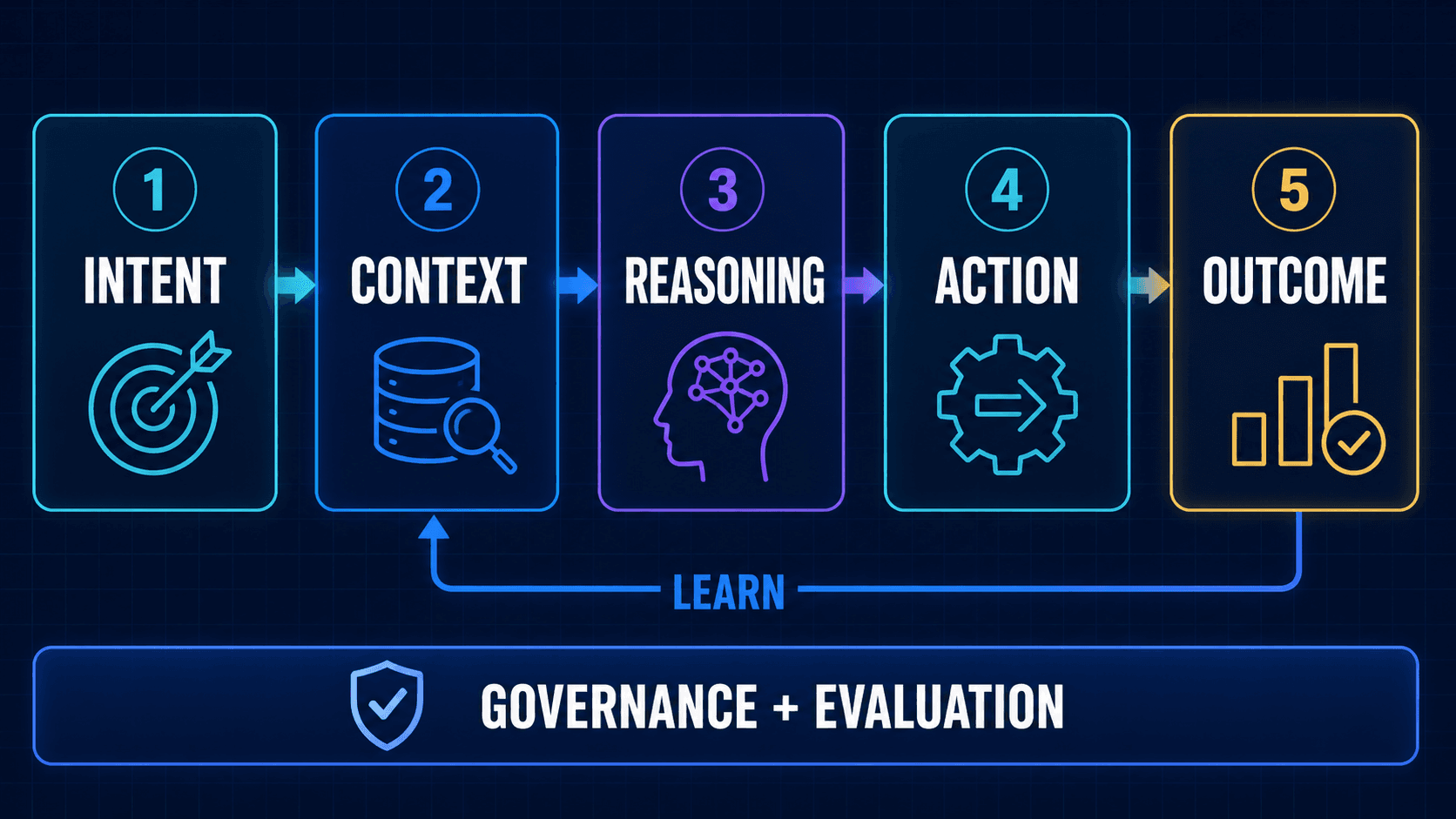 EAINE — Context-Aware Intelligence Framework · EAINE original AI-assisted research illustration
Stage 1: Intent
The system identifies what the actor is trying to achieve and distinguishes among information, recommendation, decision support, and execution.
The intent stage should establish:
- actor identity and role;
- declared and inferred objective;
- current workflow or case;
- risk and consequence level;
- expected output or action;
- accountable authority.
This stage prevents a common failure: treating a natural-language request as complete when the underlying decision boundary remains ambiguous.
Stage 2: Context
The system assembles the information required for that intent. Candidate context may come from enterprise records, documents, knowledge graphs, event streams, policy services, previous decisions, permitted memory, and tool observations.
The context stage must do more than retrieve. It must:
- enforce access and purpose constraints;
- determine authoritative sources;
- verify freshness and effective dates;
- identify missing or conflicting evidence;
- separate trusted instructions from untrusted content;
- preserve citations and provenance;
- construct a task-specific context package.
W3C PROV provides a general model for describing entities, activities, and responsible agents 9. The proposed framework applies the same principle operationally: material context should remain traceable through retrieval, transformation, reasoning, and outcome.
Stage 3: Reasoning
The system selects the appropriate combination of model, deterministic rules, analytic services, and human expertise. The model is not assumed to be the sole decision mechanism.
Reasoning should be constrained by:
- the declared objective;
- the assembled evidence;
- policy and authority boundaries;
- uncertainty and missing-context indicators;
- required explanation and citation behavior;
- stop and escalation conditions.
This stage should also preserve the hierarchy between trusted system instructions, user requests, and retrieved or third-party content. Research on instruction hierarchy addresses the need to prioritize privileged instructions over conflicting lower-trust content 10. Architecture must reinforce that separation rather than delegate the entire burden to model behavior.
Stage 4: Action
The system translates reasoning into a recommendation, workflow transition, tool call, or human task.
Action requires explicit control of:
- permitted tools and operations;
- read versus write authority;
- approval thresholds;
- idempotency and rollback;
- precondition validation;
- separation of duties;
- execution evidence.
An action can be technically successful and still be organizationally wrong. The framework therefore treats tool execution as part of the governed decision path, not as an implementation detail.
Stage 5: Outcome
The system records what happened after the response or action. Outcome evidence may include acceptance, correction, override, escalation, business effect, user impact, policy exception, and delayed downstream consequences.
The outcome stage answers a question that model-centric evaluation often misses:
Did the complete system improve the decision or operation it was designed to support?
Controlled learning then uses reviewed outcome evidence to improve source quality, context contracts, retrieval, policies, prompts, tools, and evaluations. Production outcomes should not automatically rewrite authoritative knowledge without governance.
6. Governance and evaluation as cross-cutting functions
Governance and evaluation operate across all five stages.
NIST AI RMF 1.0 frames AI risk management through the functions govern, map, measure, and manage 7. The Generative AI Profile extends risk considerations to generative systems and their lifecycle 8. The proposed framework aligns these ideas with runtime architecture.
| Framework stage | Governance question | Evaluation question |
|---|---|---|
| Intent | Is the purpose permitted and the accountable actor known? | Was the task and decision boundary correctly identified? |
| Context | Is every material source authorized, current, and traceable? | Did the package contain the necessary evidence without excessive exposure? |
| Reasoning | Are instructions, evidence, and uncertainty handled within policy? | Was the conclusion supported, calibrated, and reproducible enough for the risk level? |
| Action | Is the operation permitted, reversible where needed, and properly approved? | Did the correct tool or workflow execute under the correct authority? |
| Outcome | Are impact, correction, and redress responsibilities defined? | Did the system create the intended business value without unacceptable harm? |
This cross-cutting model avoids placing governance after the response has already been generated. Controls become part of context selection, reasoning, action, and learning.
7. The context contract
The proposed framework requires a concrete design artifact: the context contract.
A context contract defines what a specific task requires before reasoning or action may proceed. It should specify:
- task and decision boundary;
- required identity and purpose claims;
- authoritative sources and precedence rules;
- minimum freshness and completeness;
- permitted memory and retention period;
- required policies and constraints;
- prohibited data and uses;
- conflict and missing-evidence behavior;
- allowed tools and approval thresholds;
- explanation, citation, and audit requirements;
- escalation and stop conditions;
- outcome measures.
This turns context into a testable interface. A team can verify whether the system assembled an acceptable context package independently of whether a model produced persuasive language.
8. Enterprise example: operational incident investigation
Consider an engineering leader asking:
Investigate why payment failures increased after the latest release and recommend the next action.
A model-centric system might receive deployment notes and telemetry summaries. A context-aware system first establishes the service, environment, time window, business impact, user authority, and whether the request permits investigation only or operational action.
It then assembles:
- release and configuration history;
- service topology and ownership;
- error, trace, and transaction signals;
- known incidents and runbooks;
- current change and rollback policies;
- business-impact thresholds;
- previous diagnostic actions;
- approval requirements.
The reasoning stage may correlate the release with a configuration change, compare affected and unaffected transaction paths, and identify competing hypotheses. The action stage may propose a rollback, open an incident, request a database diagnostic, or escalate to the service owner. The system should not execute a production change merely because the tool is available.
The outcome stage records whether the recommendation was accepted, whether the error rate recovered, whether the hypothesis was correct, and which contextual signals were decisive or missing.
The system's value comes from the whole path. Model quality matters, but model quality alone cannot supply service authority, policy, current state, and accountable execution.
9. Evaluation model
Evaluation should measure three connected layers.
9.1 Context quality
- authoritative-source coverage;
- material-evidence recall;
- irrelevant-context rate;
- freshness and policy-version accuracy;
- conflict and missing-context detection;
- access-control correctness;
- provenance completeness;
- assembly latency and cost.
9.2 Reasoning and action quality
- evidence-grounded conclusion quality;
- uncertainty calibration;
- citation correctness;
- policy compliance;
- tool and workflow selection;
- approval and stop-condition adherence;
- robustness to untrusted contextual instructions.
9.3 Outcome quality
- task success and business effect;
- correction and override rate;
- harmful or unauthorized outcome rate;
- escalation appropriateness;
- time saved and operational cost;
- user trust and contestability;
- performance across roles, regions, and risk groups.
These measures should be analyzed together. Increasing retrieval volume may improve evidence recall while increasing irrelevant content, exposure, latency, and reasoning error. A context-aware system therefore requires balanced evaluation rather than optimization against one relevance score.
10. Enterprise architecture implications
The framework changes the role of several enterprise capabilities.
Identity becomes runtime context. Role, delegation, purpose, and consent affect what the system may know and do.
Knowledge becomes governed evidence. Documents, graphs, records, and event streams need ownership, authority, versioning, and provenance.
Memory becomes lifecycle-managed state. Short-term interaction memory, workflow memory, and durable organizational knowledge require different controls.
AI platforms become context orchestration platforms. Their responsibility expands beyond model gateways to source registration, policy enforcement, assembly, evaluation, and observability.
Applications become capabilities. Existing systems remain essential, but intelligent experiences may discover and coordinate their APIs and workflows around user intent.
Human oversight becomes an architectural role. Approval, exception handling, redress, and accountability must be designed into consequential paths.
The resulting architecture is not model-independent in the sense that all models behave identically. It is model-portable in the sense that enterprise meaning, policy, evidence, and authority do not have to be rebuilt around every model change.
11. Adoption pathway
Enterprises can test the framework without building a universal context platform.
Phase 1: Select one bounded decision
Choose a workflow with clear business value, known sources, and an accountable owner. Document the decision boundary and current failure modes.
Phase 2: Define the context contract
Identify identity requirements, authoritative sources, freshness rules, conflicts, permissions, tools, approvals, and outcome measures.
Phase 3: Build the observable path
Instrument all five stages. Record what context was assembled, which evidence influenced reasoning, what action was proposed or executed, and what outcome followed.
Phase 4: Evaluate adversarially and operationally
Test stale policies, conflicting records, missing evidence, unauthorized users, injected instructions, tool failure, and ambiguous intent—not only ideal prompts.
Phase 5: Standardize reusable capabilities
Promote repeated components such as source registries, policy checks, context packaging, provenance, memory controls, and evaluation into shared platform services.
12. Practical boundaries and next steps
This framework is a conceptual architecture pattern based on a structured synthesis of published research and practitioner experience. It has not yet been empirically validated across enterprise domains.
It should be adapted and independently evaluated for each organization's operational context, security requirements, governance obligations, risk profile, and human-oversight needs. The framework does not guarantee accuracy, eliminate model or security risk, or replace domain-specific evaluation.
Several specific limitations remain.
First, controlled comparisons between model-centric and context-aware architectures have not yet established the framework's effect on enterprise outcomes.
Second, context sufficiency is domain-dependent. Evidence required for software operations differs from evidence required for finance, healthcare, legal, or human-resources decisions.
Third, greater context governance can increase latency, engineering effort, and organizational coordination costs. Those costs should be measured against error reduction and business value.
Fourth, provenance and logging can create additional sensitive records. Observability must itself follow privacy, security, and retention policy.
Future research should therefore examine:
- benchmark tasks for context assembly quality;
- causal attribution between context defects and outcome failures;
- context-contract portability across models and platforms;
- evaluation of hierarchical and graph-based context strategies;
- secure separation of trusted instruction and untrusted evidence;
- memory correction, expiration, and consent withdrawal;
- human factors in escalation, contestability, and accountability;
- cost and latency trade-offs across risk tiers;
- longitudinal measurement of business outcomes.
13. Conclusion
Enterprise AI is moving from isolated model capability toward integrated system responsibility.
The model remains important. It may interpret language, synthesize evidence, generate hypotheses, plan actions, and adapt to new information. But it cannot determine enterprise truth, authority, purpose, policy, and accountability by itself.
The proposed context-aware intelligence framework makes those responsibilities explicit:
Intent → Context → Reasoning → Action → Outcome
Governance and evaluation span the complete path. Controlled learning connects reviewed outcomes back to future system improvement.
The shift from model-centric AI is therefore not a rejection of better models. It is a recognition that enterprise value depends on what the system builds around them.
The next generation of AI-native systems will not be defined only by how intelligently they answer.
They will be defined by how reliably they understand the situation, respect the boundary, act with authority, preserve evidence, and improve outcomes for accountable people.
References
- Retrieval-Augmented Generation for Knowledge-Intensive NLP TasksLewis et al.Accessed August 11, 2026
- Lost in the Middle: How Language Models Use Long ContextsLiu et al.Accessed August 11, 2026
- Self-RAG: Learning to Retrieve, Generate, and Critique through Self-ReflectionAsai et al.Accessed August 11, 2026
- MemGPT: Towards LLMs as Operating SystemsPacker et al.Accessed August 11, 2026
- From Local to Global: A Graph RAG Approach to Query-Focused SummarizationEdge et al.Accessed August 11, 2026
- ReAct: Synergizing Reasoning and Acting in Language ModelsYao et al.Accessed August 11, 2026
- Artificial Intelligence Risk Management Framework (AI RMF 1.0)National Institute of Standards and TechnologyAccessed August 11, 2026
- Artificial Intelligence Risk Management Framework: Generative Artificial Intelligence ProfileNational Institute of Standards and TechnologyAccessed August 11, 2026
- PROV-O: The PROV OntologyWorld Wide Web ConsortiumAccessed August 11, 2026
- The Instruction Hierarchy: Training LLMs to Prioritize Privileged InstructionsWallace et al.Accessed August 11, 2026
Publication detailsVersion 1.1.0 · Updated August 11, 2026 · Editorially approved
- v1.1.0
Converted the working paper into an accessible, evidence-led article while preserving the framework, references, and practical limitations.
- v1.0.1
Reframed the disclaimer as transparent research metadata, clarified validation boundaries, and finalized the published illustration attribution.
- v1.0.0
Approved and published the Tuesday EAINE research paper with verified references, accessible visuals, and dedicated social metadata.
- v0.1.0
Created the Tuesday working-paper draft from the locked EAINE editorial plan, with a proposed context-aware intelligence framework and original research visuals.