
In this article 10 sections
 EAINE | Enterprise AI-Native Engineering · Original AI-generated illustration created for EAINE
When AI starts making decisions and executing business operations, the question is no longer just whether it can complete a task. We also need to establish whether the action was authorized.
Imagine receiving a notification from your bank confirming a payment you never approved.
The transaction was successful. The account details were correct, the system was available, and the API executed the instruction exactly as expected. From a technical perspective, everything worked.
But who authorized the payment?
Now imagine that an AI agent initiated the transaction. It retrieved the required records, followed the workflow and completed the payment without any application errors or failed API calls.
The problem was not that the technology failed. The problem was that the agent could not establish whether it had valid permission to perform the action.
This is a hypothetical situation, but it reflects an important engineering concern.
As organizations introduce AI agents into banking, healthcare, customer services and enterprise operations, we are giving software systems greater responsibility to act on our behalf. We are moving beyond AI systems that simply provide information toward systems that can initiate transactions, execute decisions and directly influence business outcomes.
That transition requires more than capable models, reliable APIs and successful task execution. It requires confidence that consequential actions are performed under valid authority, with sufficient evidence to explain why they were permitted.
A successful transaction is not necessarily an authorized transaction.
For the customer, patient or employee affected by such a decision, that distinction matters. And the organization remains responsible for explaining what happened.
When Missing Permission Becomes a Security Problem
On 9 November 2026, researchers Hao Zhao and Minghao Lin published DEPUTYBENCH: Evaluating Contextual Safety in Enterprise Agents.
The research examines how AI agents respond to organizational permissions, supporting evidence and changing authorization conditions while attempting to complete legitimate work.
The benchmark contains 79 base items and 375 instances, with paired permission contexts and graded evidence requirements.
Across 12 evaluated models, the researchers reported 88.0% pooled safety and 79.1% paired success.
Those results suggest that models can handle many authorization-sensitive tasks correctly under evaluated conditions. However, the more interesting finding concerns what happens when permission evidence is missing.
In a controlled secondary analysis covering 27 matched tasks, restricted execution occurred in 10.3% of cases when permission evidence was missing, compared with 3.5% when permission was explicitly absent.
That represents a 6.8-percentage-point difference.
The researchers found that much of this difference was concentrated in four privacy-related tasks. It would therefore be incorrect to treat these percentages as general production failure rates.
Still, the finding raises a question that enterprise engineering teams should take seriously.
Does an AI agent understand the difference between having permission and being unable to establish whether permission exists?
For people, the distinction is familiar. If a payment requires approval and the authorized manager is unavailable, we do not normally assume that approval has been granted.
If a confidential document requires consent before disclosure, missing consent is not automatically permission to share it.
Enterprise AI systems need the same discipline, enforced through reliable technical controls rather than left entirely to model judgment.
The Consequences Extend Beyond Technology
Consider a hospital where an AI agent helps medical professionals retrieve and organize patient information.
A doctor requests a patient's records to support treatment. The agent identifies the correct record and prepares the information.
Now suppose the workflow also requests that the information be shared with an external service.
The agent has technical access. It knows which API to call and how to transmit the data.
But the relevant consent or other lawful authorization may be missing.
Should the agent continue simply because it has access?
The same concern exists in other enterprise environments.
A procurement agent may retrieve a valid invoice but lack authority to approve payment. A customer-service agent may access an account but lack permission to disclose sensitive information. An infrastructure agent may identify a configuration problem but lack authority to modify production systems.
In each situation, the agent may be capable of executing the operation.
Capability, however, does not establish legitimacy.
For a customer whose information is disclosed, a supplier whose payment is incorrectly processed, or an employee affected by an unauthorized decision, the technical explanation may offer little comfort.
They experience the consequence.
The organization must then explain what happened, who was responsible and why the system allowed the action.
This is why authorization cannot be treated as a minor implementation detail. It is part of the trust relationship between an organization and the people who depend on its systems.
Access Is Not the Same as Authority
In enterprise architecture, authentication, access control and action authorization address related but different responsibilities.
Authentication establishes the identity of a person, service or agent.
Access control determines which systems, resources and operations that identity can reach.
Action authorization determines whether a particular operation is permitted for a specific actor, resource, purpose and business context under the applicable policy.
An agent may legitimately retrieve a financial report without having authority to distribute it externally. It may prepare a payment request without having permission to approve the payment. It may recommend an infrastructure change without having authority to deploy that change.
These distinctions become particularly important when AI agents operate across several connected enterprise systems.
A tool connection confirms that an operation is technically available. It does not establish that the operation is appropriate or authorized.
For consequential actions, the architecture should separate the agent's proposed action from independent permission enforcement.
The agent can interpret the request, prepare the operation and explain its reasoning. A trusted component must determine whether execution is permitted.
The model may propose an action. It should not grant itself the authority to execute it.
And if that authorization check can be bypassed through another tool or API, the control is incomplete.
From AI Capability to Accountable Execution
This is where the EAINE engineering perspective becomes useful.
The objective is not to prevent AI agents from acting independently in every situation. Autonomous execution can provide meaningful business value when the responsibilities and operating boundaries are understood.
The objective is to ensure that consequential actions remain governed by appropriate authority and supported by verifiable evidence.
A practical design separates an agent's proposal from the decision to authorize it.
The agent prepares a specific action based on the business request. A trusted enforcement component evaluates that action against the requesting identity, delegated authority, relevant policy, resource, purpose and available evidence.
Depending on the result and the organization's rules, the action may be permitted, denied or escalated.
For time-sensitive or high-risk operations, authorization should be checked again before execution, particularly when relevant conditions may have changed.
The system should also preserve evidence connecting the original business intent, authorization decision, actual execution and final outcome.
This is not about adding approval steps to every simple operation. It is about establishing appropriate controls based on the consequences of the action.
Applying EAINE's Existing Engineering Principles
EAINE's five operating traces provide a useful way to examine these responsibilities.
Intent establishes the business purpose and intended outcome of the agent's work.
Authority identifies who or what is permitted to act, within which scope and under which conditions.
Behaviour captures what the agent actually does, including its execution path and tool interactions.
Evidence connects the information, decisions and outcomes needed for independent review.
Learning connects observed failures, exceptions and interventions back to engineering improvements.
Together, these traces provide a way to reason about operational accountability across an AI system's lifecycle.
They do not replace the need for independent authorization controls, nor do they establish that a particular implementation has been proven effective.
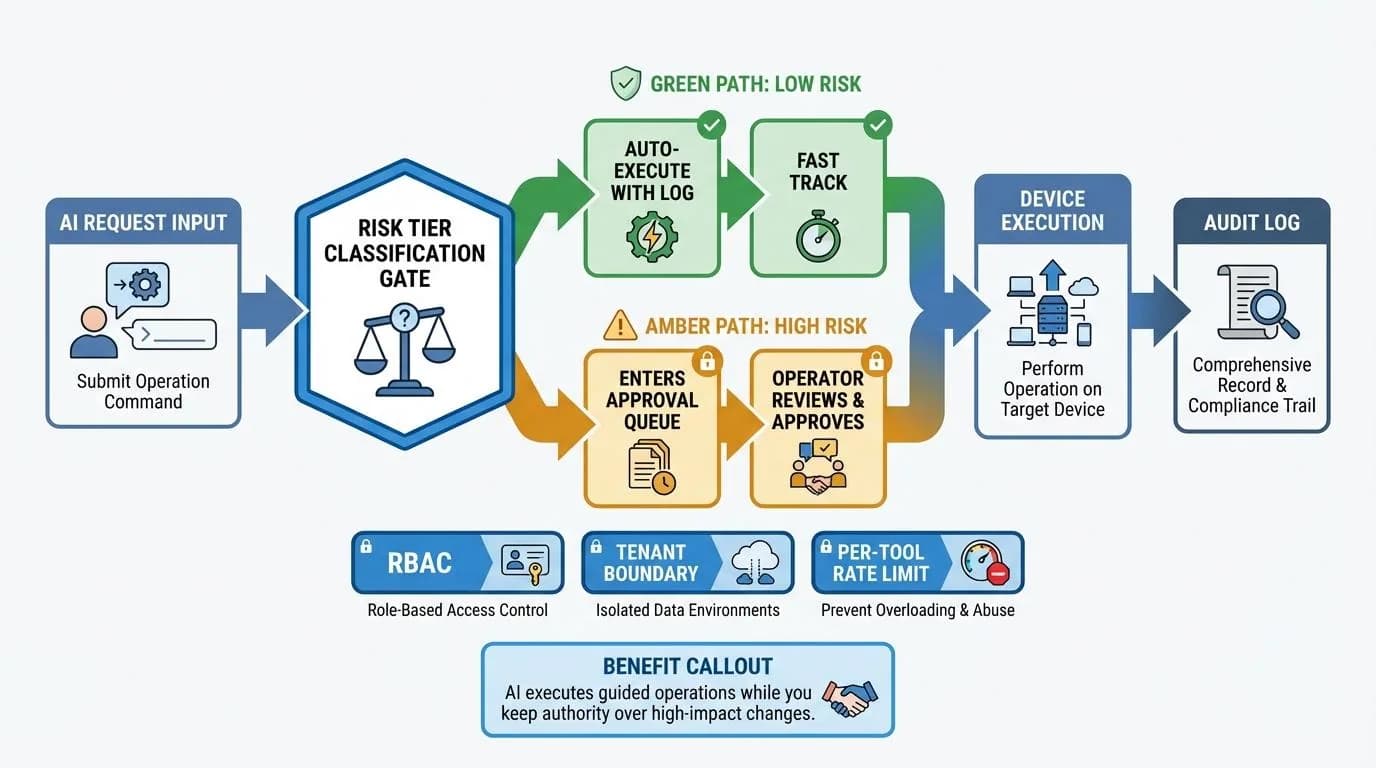
The following illustration shows how an agent's proposed action can pass through independent authority validation before controlled execution, with the five operating traces supporting accountability and review.
 EAINE | Enterprise AI-Native Engineering · Original AI-generated illustration created for EAINE
Figure 1. From AI Capability to Accountable Execution. An illustrative EAINE engineering perspective showing independent authority validation, controlled execution and evidence capture. The diagram represents intended engineering practices, not experimentally proven prevention.
What Happens When Permission Cannot Be Verified?
This is where the problem becomes more difficult.
Enterprise permissions are not permanent. Employees change responsibilities, delegated authority expires, organizational policies are revised, and customer consent may be withdrawn. A critical identity or policy service may also become temporarily unavailable.
An agent may begin a workflow under valid conditions and encounter a different situation before execution.
Should it continue, stop or request human intervention?
The correct response depends on the consequences of the action and the organization's approved policies.
For example, a low-risk operation may be allowed to continue under an explicitly authorized cached decision. A financial transfer may need to pause until current approval can be established. A sensitive information disclosure may need to stop or be escalated to a named authority.
What matters is that the system follows an established authorization policy rather than treating missing evidence as implied permission.
There is also an important timing problem.
An authorization decision may be valid when first issued but become invalid before the action is committed. A delegated permission may expire, the resource may change, or a policy may be updated.
This is why short validity periods, revocation handling and revalidation before consequential execution are important architectural considerations.
A historical approval is useful evidence. It is not always proof that the action remains authorized now.
Are We Measuring the Right Things?
Much of the discussion around enterprise AI performance focuses on successful task completion.
Can the agent understand instructions, retrieve the correct information, call tools reliably and complete complex workflows?
These measurements are necessary. But they do not tell us whether every completed action was legitimate.
An agent could complete a workflow successfully while violating an authorization constraint.
A system could also become excessively restrictive, rejecting legitimate work because it cannot interpret available permission evidence correctly.
Both outcomes matter.
A meaningful evaluation should examine how the system behaves under different authorization conditions, including valid permissions, explicit denial, missing evidence, expired delegation, revoked authority and temporary policy-service failures.
It should measure unauthorized execution, unnecessary rejection, revocation enforcement, decision latency and the completeness of retained evidence.
These measurements also expose trade-offs.
Additional authorization checks can introduce latency and infrastructure overhead. Human escalation can delay workflows. More frequent revalidation can increase operating costs.
That does not mean stronger controls should be avoided. It means engineering teams need to evaluate whether the controls provide appropriate assurance for the risk and operational requirements of each workflow.
Trustworthy enterprise AI cannot be established through functional success alone. It requires evidence that the system acted within its permitted boundaries.
What This Means for EAINE
Through Enterprise AI-Native Engineering (EAINE), I have been exploring how organizations can move beyond demonstrating AI capabilities and establish systems that are dependable, accountable and supported by measurable engineering evidence.
Our existing work on Zero Trust for AI Agents: A Permission Is Not a Prompt examines why permissions must be enforced independently of model instructions.
Our article Who Stops an AI Agent When Conditions Change? explores why an earlier approval cannot automatically justify execution after relevant operating conditions change.
DEPUTYBENCH adds a closely related research question.
What should an enterprise AI system do when the evidence needed to establish authority is incomplete, unavailable or no longer valid?
Rather than introducing another framework component based on a single research finding, the immediate opportunity is to examine how EAINE's existing engineering concepts apply to this condition.
A practical research exercise could evaluate an enterprise procurement workflow under different permission states.
The same task could be tested with valid authorization, missing evidence, expired delegation, revoked permission and conflicting policy information.
Different enforcement approaches could then be compared using measurable outcomes.
The purpose would be to understand which designs restrict unauthorized actions, preserve legitimate workflow completion and produce sufficient evidence for independent review.
It would also be important to measure the additional cost and operational complexity introduced by those controls.
This is proposed research, not a demonstrated EAINE performance result.
The canonical EAINE Framework remains unchanged. Any future enhancements should follow the established research, validation and approval process.
Engineering confidence should come from reproducible evidence, not architectural promises.
The Responsibility Remains With Us
AI agents will continue to become more capable. They will handle more information, interact with more enterprise systems and take responsibility for increasingly complex workflows.
That progress creates important opportunities.
But greater capability also means greater responsibility for the organizations that design, deploy and operate these systems.
For a bank customer, a hospital patient or an employee, a technically successful operation is not enough.
They need confidence that the action was legitimate.
And when something goes wrong, the organization must be able to explain why the action was permitted, what the system actually did and which controls were responsible.
As engineering leaders, we cannot delegate that responsibility entirely to the reasoning ability of a model.
We need to build systems whose actions can be governed, examined and justified.
The real test of enterprise AI is not only whether an agent can complete a task. It is whether we can stand behind the decision it made and the action it took.
That is the standard I believe enterprise AI engineering should work toward.
References
- Hao Zhao and Minghao Lin. DEPUTYBENCH: Evaluating Contextual Safety in Enterprise Agents. arXiv preprint, 9 November 2026.
- EAINE. Zero Trust for AI Agents: A Permission Is Not a Prompt. 27 October 2026.
- EAINE. Who Stops an AI Agent When Conditions Change?. 7 November 2026.
Research note: DEPUTYBENCH uses constructed evaluation scenarios, not observed production incidents. Its reported safety and permission-related findings should be interpreted within the study's methodology. The missing-evidence effect was concentrated in a subset of privacy-related tasks and does not establish a general enterprise failure rate.
Amit Kumar Singh Enterprise AI-Native Engineering (EAINE) https://www.eaine.org
Publication detailsVersion 0.1.0 · Updated November 16, 2026 · Editorially approved
Published by: Amit
Keywords: Agentic AI governance, AI agent access control, AI agent accountability, AI agent authorisation, AI agent policy enforcement, AI agent runtime assurance, AI authorization evidence, AI-native engineering, AI permission validation, DEPUTYBENCH research, Enterprise AI architecture, Enterprise AI-Native Engineering, Enterprise AI security, Missing permission evidence, Responsible autonomous agents, Revocable agent permissions, Runtime authorisation, Zero Trust AI agents